
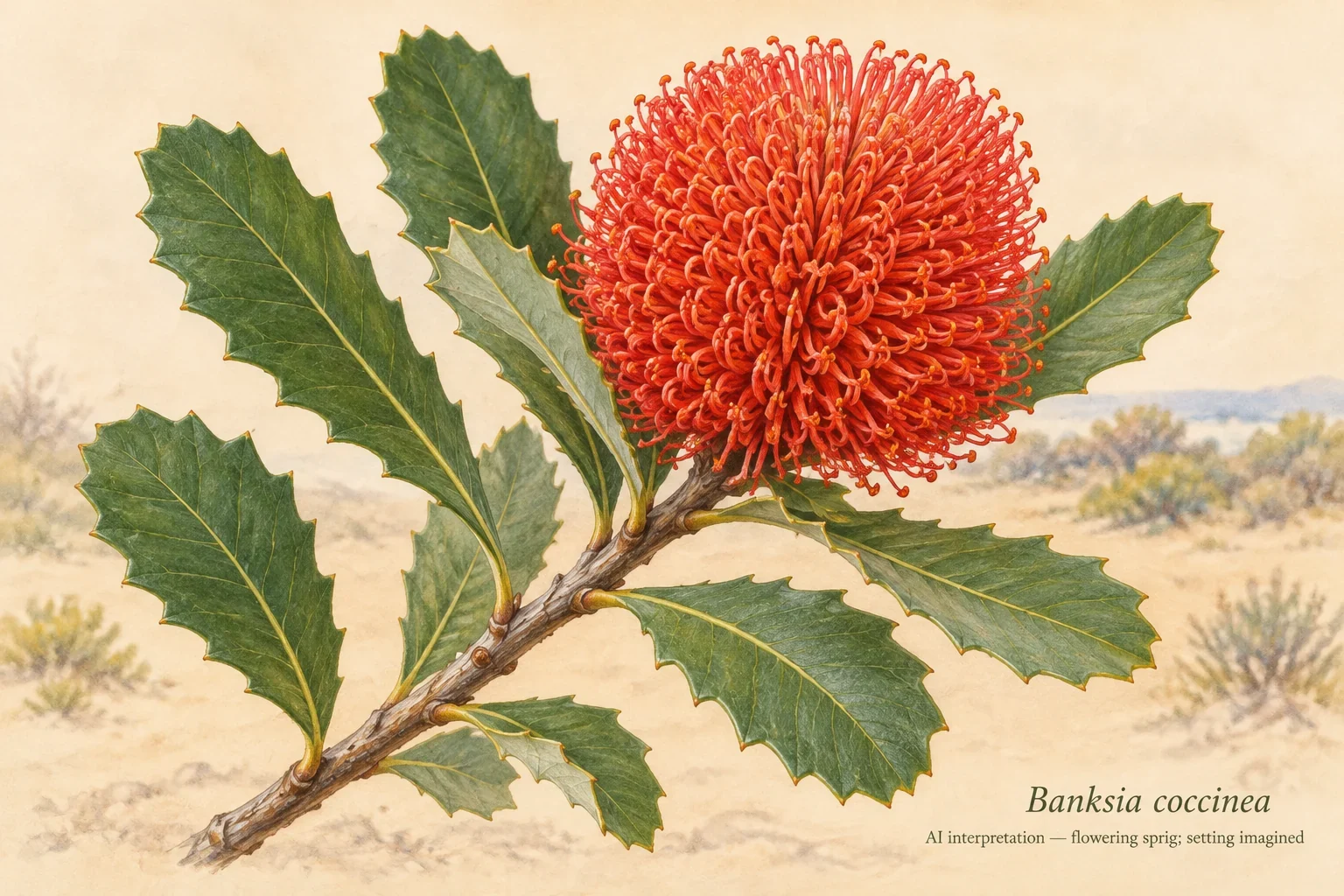
AI scarlet banksia spike with broad toothed leaves.
AI interpretation of scarlet banksia flowering; setting imagined.
Overview
The native-plant account places scarlet banksia in woodland on deep coastal sand. Broad toothed leaves accompany orange-red terminal flower spikes, roughly as wide as long. Woody cones retain seeds; lacking a lignotuber, the plant regenerates from seed after fire.
Fuss and Sedgley’s controlled pollinations found protandry and partial self-incompatibility. Stigmas became most receptive three days after flower opening. Crosses improved fruit and seed production compared with selfing or open pollination, while space and resources also limited fertility.
The account adopts Banksia’s expanded circumscription following the transfer of Dryandra. This genus-level classification and the species’ reproductive experiments provide different kinds of evidence; pollen performance alone does not establish a complete molecular species tree.
Origins & earliest records
A native-plant account is paired with a 1991 reproductive experiment.
Evidence & interpretation
Retained morphology and the complete indexed primary abstract distinguish flowering structure from tested fertility.
Selected bibliography
Documented works and useful reading. This is not a list of every appearance.
- 01
- 02
Family, evolution & connections
Taxonomic classification
A hierarchy of classified groups, not a chain of direct ancestors.
Source note: The adopted genus includes former Dryandra species.
- FamilyProteaceae
- GenusBanksia
References
Sources supporting this profile. Linked pages have their own scope and editorial standards.
- Specialist botanical accountNative plant accountResearch access: 2026-10-11
- Retained indexed primary abstractPollination experimentResearch access: 2026-10-11
Image credits
AI-generated interpretationAI scarlet banksia spike with broad toothed leaves.
AI interpretation of scarlet banksia flowering; setting imagined.