
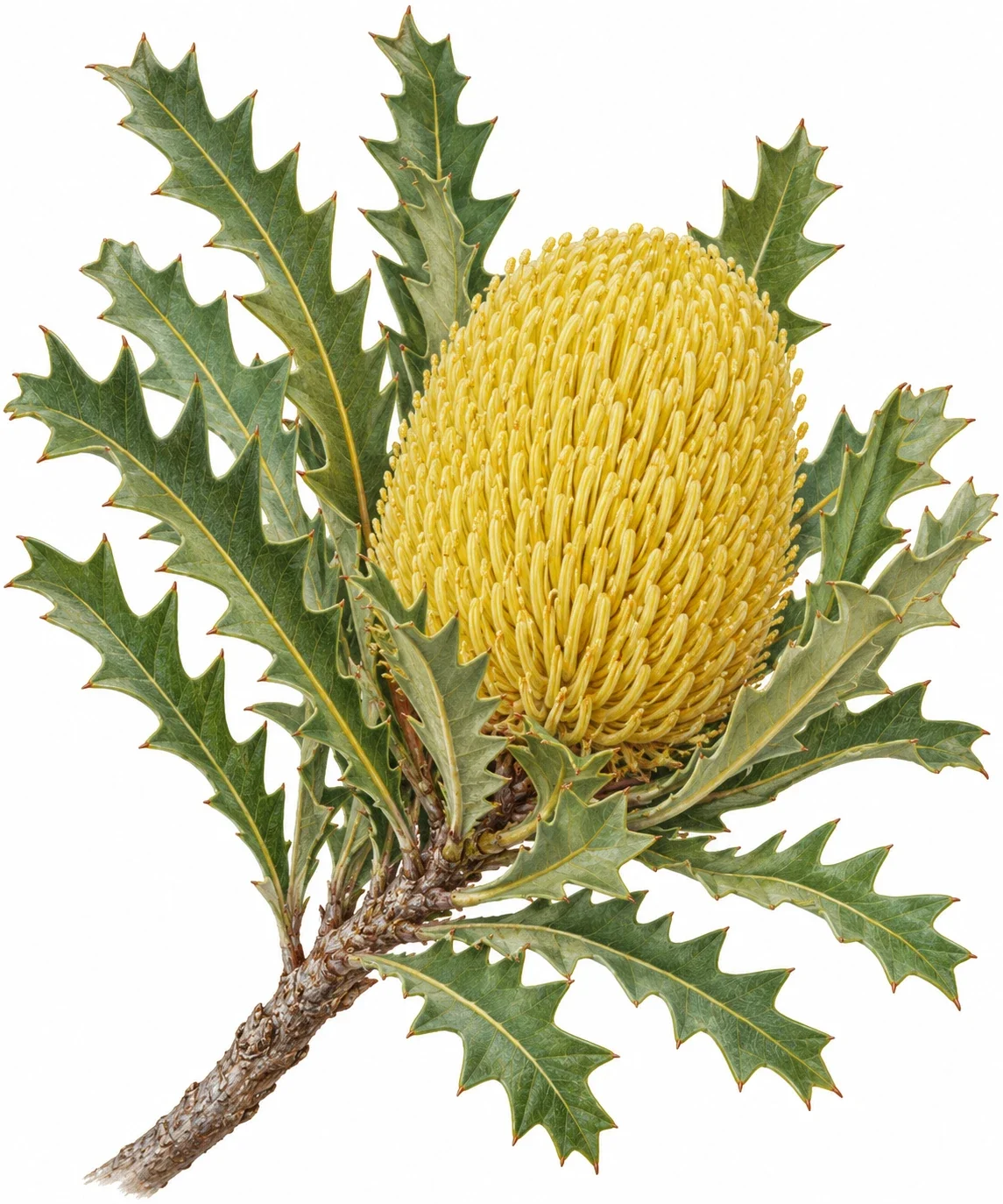
AI-generated botanical study.
Interpretive portrait; no authenticated specimen claim.
Overview
Banksia baxteri is an openly branched shrub reaching four metres. Stiff mature leaves carry conspicuous triangular lobes, while new growth is softer, hairy and rust-coloured. Lemon-yellow flower heads terminate the branches within a surrounding rosette of leaves. The Australian National Botanic Gardens describes these heads as ovoid; Kings Park emphasizes their rounded, hemispherical form rather than the cylinders familiar in many banksias.
Woody follicles retain seeds in the canopy. Adults lack a lignotuber and are killed by fire, making seedling recruitment important after burning. Kings Park places its wild range near the southern coast of Western Australia, from the Stirling Range towards the Oldfield River, and displays it in its Banksia and Stirling Range gardens.
Origins & earliest records
Sandy coastal habitats
Evidence & interpretation
Institutional botanical evidence.
Selected bibliography
Documented works and useful reading. This is not a list of every appearance.
- 01
- 02
Family & connections
A source-supported family tree or inspiration record has not yet been compiled for this profile. Related reading below indicates a connection in subject matter, not a proven lineage or creative influence.
Look for a taxonomic record and classified relativesReferences
Sources supporting this profile. Linked pages have their own scope and editorial standards.
- Botanic-garden accountBanksia baxteriResearch access: 2026-10-23
- Botanic-garden accountBanksia baxteriResearch access: 2026-10-23
Image credits
AI-generated interpretive illustrationAI-generated botanical study.
Interpretive portrait; no authenticated specimen claim.