
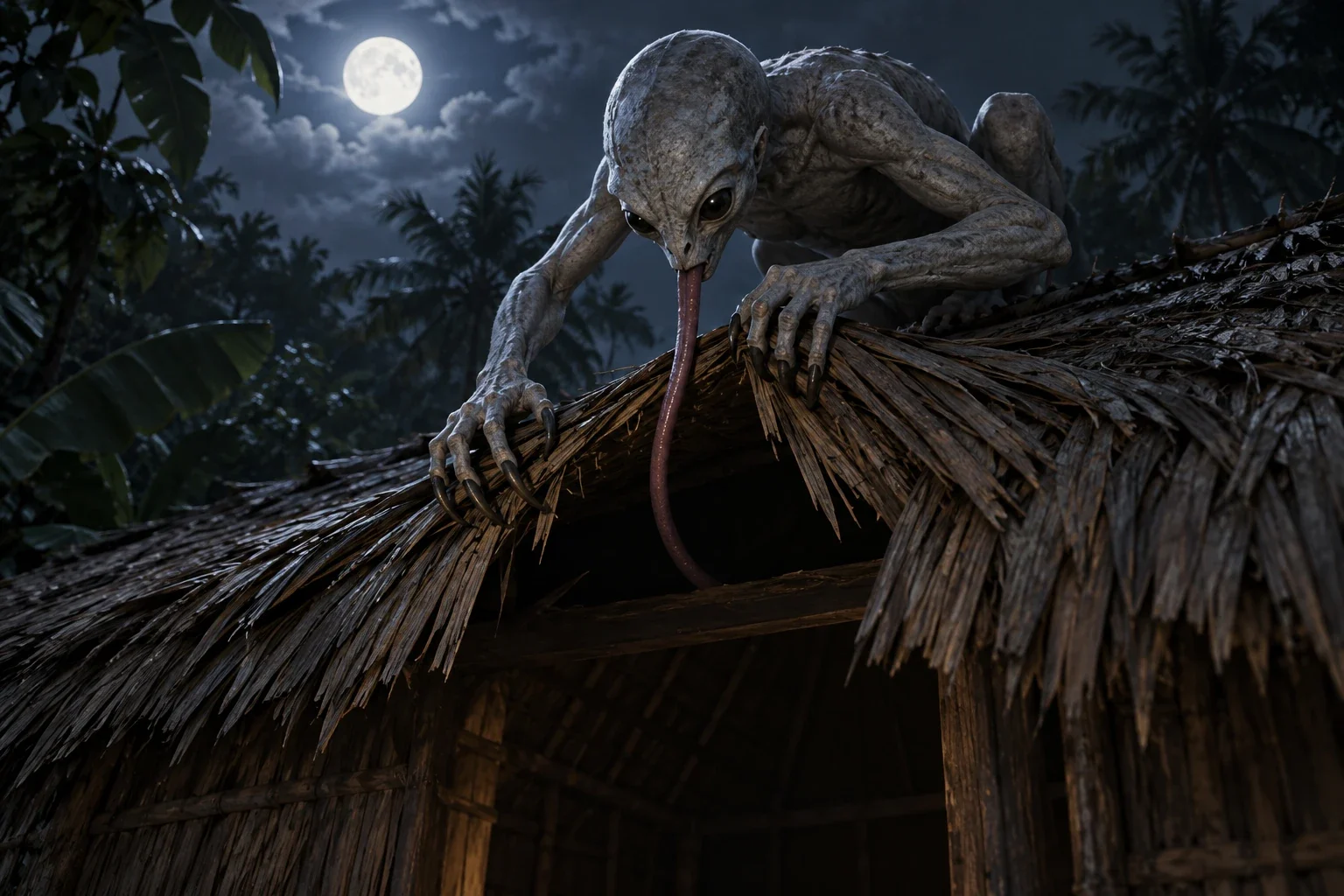
Balbal - AI-generated imagined folklore illustration.
AI-generated imagined illustration of Balbal based on the selected textual witness; not historical or ethnographic evidence.
Overview
Worcester records the balbal in his account of a second visit to Palawan. While a corpse awaits burial, the Tagbanua people he describes fear a man-like mythical creature. Its curved nails tear house thatch, and its long tongue reaches down toward the body. It travels through the air in a manner compared with a flying squirrel; the passage does not explicitly describe bat wings or a flying-squirrel membrane.
The reported danger belongs to the interval before burial. Worcester places it after a description of funeral arrangements and before discussion of the afterlife. He says people locate its origin in the Moro country. This is an attributed geographical belief inside a colonial record, not an assertion about actual Moro communities.
The short passage supplies no named individual, extended encounter, banana-trunk substitute or comprehensive classification of Philippine spirits. Those commonly added motifs cannot be introduced from this source. It likewise does not establish that balbal and other corpse-eating beings are synonyms. The chosen illustration concentrates on nails, thatch and tongue while omitting a victim.
Origins & earliest records
Worcester, The Philippine Islands and Their People (1898), p.109; printed witness rather than oral origin date.
Records & interpretation
Complete balbal paragraph and preceding/following funeral context inspected in original-edition OCR, p.109.
Selected bibliography
Documented works and useful reading. This is not a list of every appearance.
- 01
The Philippine Islands and Their People
Second Visit to Palawan, p.109; colonial framing and unnamed informants acknowledged.
Family & connections
A source-supported family tree or inspiration record has not yet been compiled for this profile. Related reading below indicates a connection in subject matter, not a proven lineage or creative influence.
References
Sources supporting this profile. Linked pages have their own scope and editorial standards.
- Located primary narrative or institutional scholarly interpretationThe Philippine Islands and Their PeopleResearch access: 2026-10-10
Image credits
AI-generated imagined folklore illustrationBalbal - AI-generated imagined folklore illustration.
AI-generated imagined illustration of Balbal based on the selected textual witness; not historical or ethnographic evidence.