
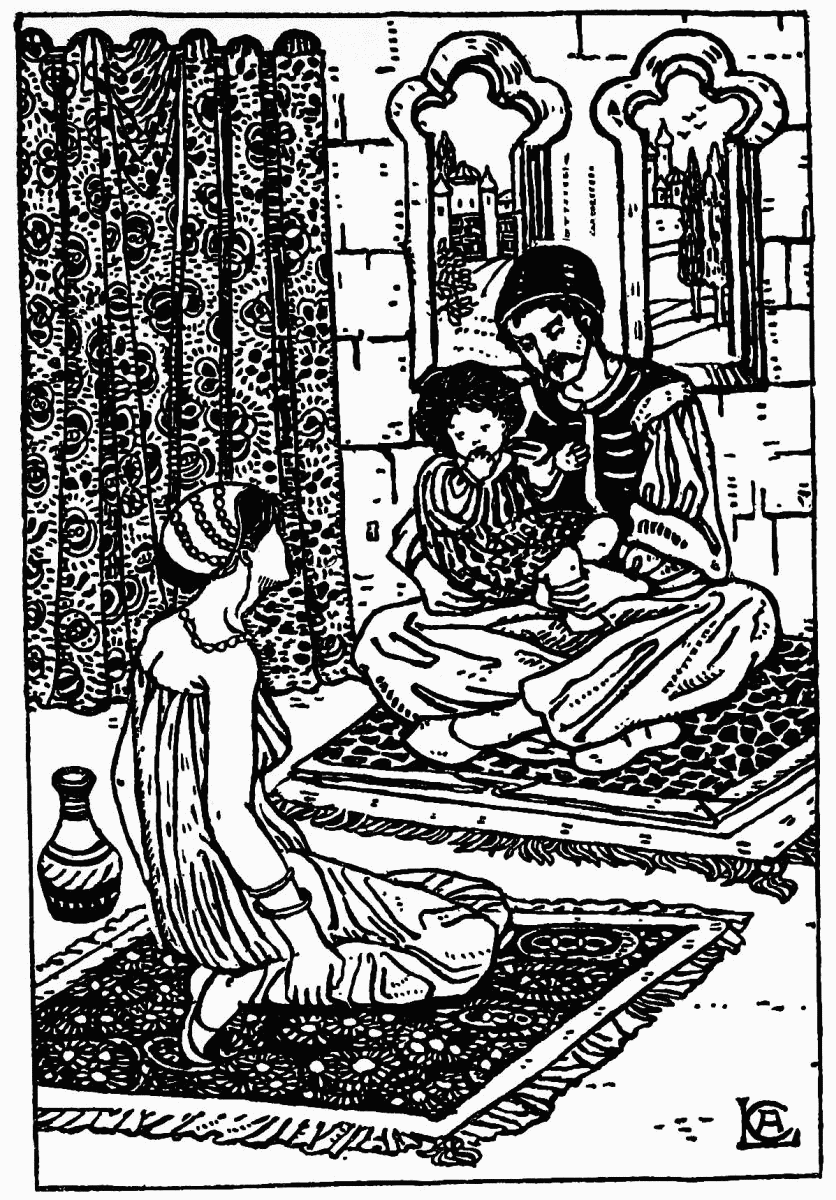
Celia Levetus’s 1901 illustration of Bahtiyar Bey in human form with his child and wife, facing page174 of The Padishah of the Peris
Levetus depicts the tale’s ruler in human form, holding his child while his wife kneels nearby. The adjacent passage describes Bahtiyar Bey changing from a dove into a man during his visits to his family. This is the 1901 illustrator’s domestic scene, not a picture of his dove form or the forty pursuing Peris.
Overview
Bahtiyar Bey, the Padishah of the forty Peris, appears to a princess as a little dove that successively steals her ring, bracelet and lace handkerchief. A traveller follows a water-carrying cock into the hidden palace and sees a white dove become a beautiful youth. In private the youth mourns over the stolen objects before returning to bird form at dawn. The traveller’s report enables the princess to find him; their reunion reveals that he too has loved her.
He explains that his mother is mortal and that the Peris stole him at three days old, making him their ruler. They permit him only two hours to himself each day. He directs the princess to his mother’s house, where the mention of Bahtiyar’s name secures her welcome; his visits continue in dove form, followed by human appearances. The princess bears their son. When the mother discovers her son’s visits, she conspires with his wife to delay him beyond the allotted time while she sets a poisoned-needle trap for the Peris.
The forty pursuing dove-Peris fall poisoned from the cypress outside, and Bahtiyar rejoices at his release and reunion with mother, wife and child. The account does not expressly remove his ability to become a dove. This entry concerns an explicitly narrated human-to-bird manifestation under fairy captivity, not a biological race of bird-people or a claim that his mortal mother was herself a Peri.
Origins & earliest records
Turkish storytelling collected in Anatolia, through Hungarian and English publication
Records & interpretation
Complete English tale and ending read, with its attached footnote where present.
Selected bibliography
Documented works and useful reading. This is not a list of every appearance.
- 01
Turkish Fairy Tales and Folk Tales
“The Padishah of the Forty Peris,” pp.166–175. London:A.H.Bullen,1901; complete English account, no attached footnote.
Family & connections
A source-supported family tree or inspiration record has not yet been compiled for this profile. Related reading below indicates a connection in subject matter, not a proven lineage or creative influence.
Primary records and illustrations
Turkish Fairy Tales and Folk Tales
Ignácz Kúnos / R. Nisbet Bain; London: A. H. Bullen, 1901. The Padishah of the Forty Peris, pp.166–175
Complete cache kunos-bain-14.txt,12753characters, no footnote. Ring/bracelet/handkerchief thefts, bath frame and healed visitors, three dove servants, mortal origin, wife/child, mother’s poisoned-needle trap and final feast all read. Two hours of freedom versus remaining Peri service; no explicit removal of bird-changing faculty at ending.
References
Sources supporting this profile. Linked pages have their own scope and editorial standards.
- Historical English folktale translation through HungarianKúnos/Bain1901, The Padishah of the Forty PerisResearch access: 2026-10-05
Image credits
Historical illustrationCelia Levetus’s 1901 illustration of Bahtiyar Bey in human form with his child and wife, facing page174 of The Padishah of the Peris
Levetus depicts the tale’s ruler in human form, holding his child while his wife kneels nearby. The adjacent passage describes Bahtiyar Bey changing from a dove into a man during his visits to his family. This is the 1901 illustrator’s domestic scene, not a picture of his dove form or the forty pursuing Peris.