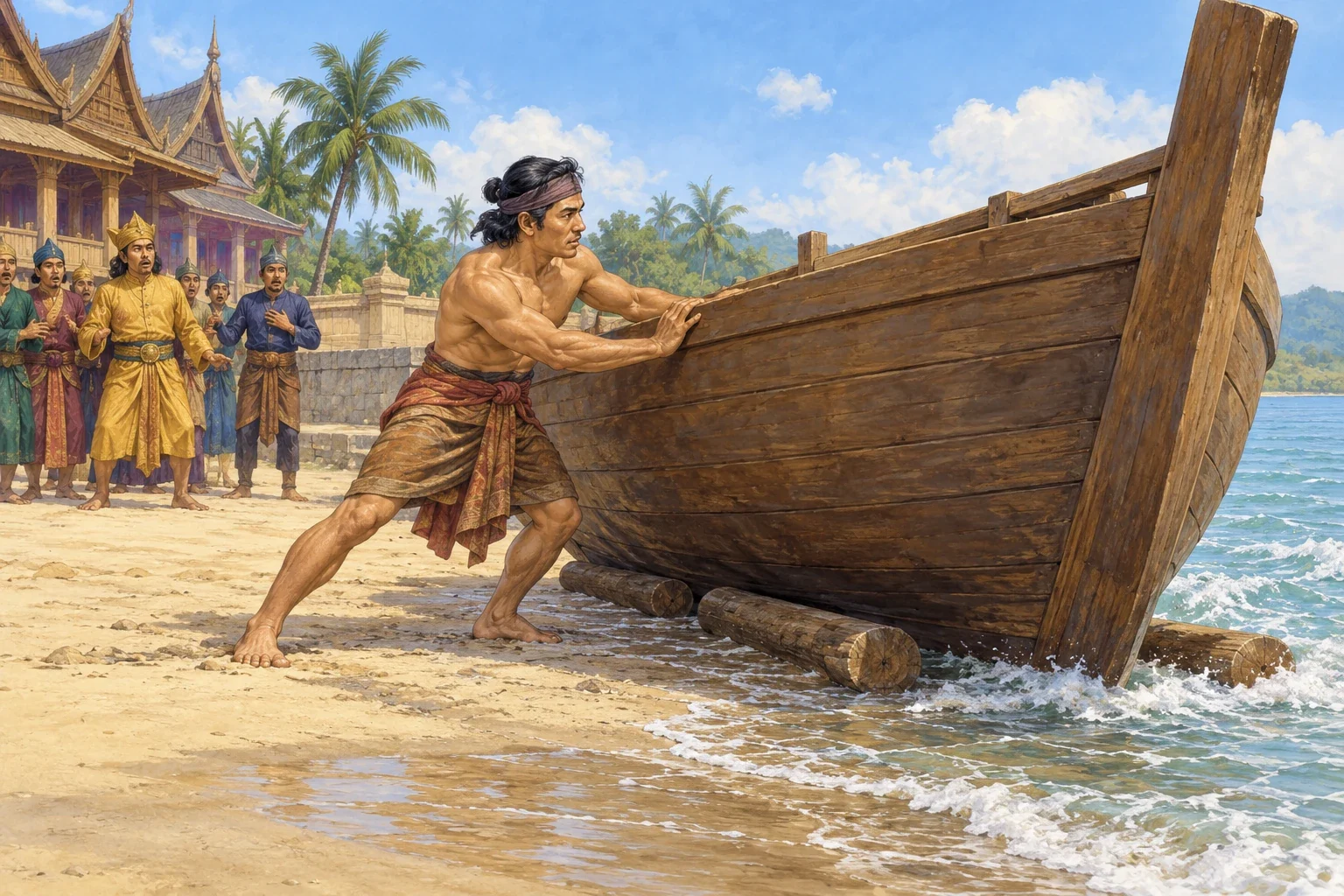
AI-generated interpretation of Badang’s boat-launching task in Leyden’s selected Malay Annals account. Body build, clothing, rollers, boat and court architecture are editorial choices, not an exact historical reconstruction.
AI-generated interpretation of Badang’s boat-launching task in Leyden’s selected Malay Annals account. Body build, clothing, rollers, boat and court architecture are editorial choices, not an exact historical reconstruction.
Overview
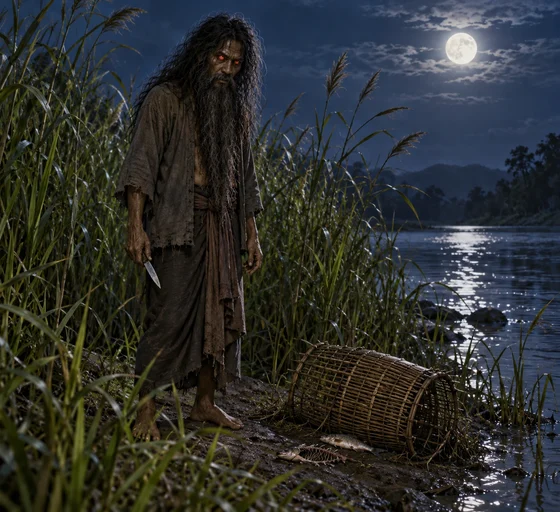
Badang begins the selected episode as an enslaved man whose work is clearing forest for a master at Salwang. The narrative identifies him with Sayang and follows his efforts to catch fish in a river. Each morning he finds the catch eaten and only scales and bones remaining. Keeping watch among the reeds, he catches the hantu responsible. The supernatural visitor offers a gift in return for release. Badang considers wealth and invisibility but rejects them as insufficient answers to his situation: wealth would belong to his master, while invisibility would not prevent death. He asks instead for strength to uproot large trees with one hand.
The hantu makes that strength conditional on Badang consuming what it vomits. Badang accepts, keeps hold of the being’s beard and tests his new power against large trees before letting it go. He clears the forest with extraordinary ease. After he explains the transformation, his master gives him freedom. The order of those events is significant: the tale does not begin with a noble champion who happens to fight a monster. It connects the supernatural bargain to forced labor, release from enslavement and the subsequent recognition of abilities that the court wishes to employ.
Sri Rama Vicrama invites Badang to Singhapura and gives him a court appointment. His strength is displayed in separate tasks. He travels alone in a large boat using a tree trunk as an oar. A fall from a kuras tree splits the stone struck by his head while leaving his skull intact. Later he launches a royal boat after successively larger groups of men have failed. These episodes precede his appointment as a champion. The narrative associates the broken stone, boat and oversized oar with places where it says they could be seen; those claims belong to the historical text’s explanation of landmarks and are not present-day verification of objects.
A visiting champion named Nadi Vijaya Vicrama comes from the land called Kling in the translation and stakes seven laden ships on a contest. After wrestling, the men test themselves with a large stone outside the ruler’s hall. The visitor can only raise it to his knee. Badang lifts it easily and throws it into the river mouth, winning the ships. A second challenger, Bandrang of Perlac, arrives under diplomatic escort. The two secretly test strength with their knees at an evening entertainment. Badang frees his own knee and pins Bandrang’s, leading the visitor to ask his envoy to cancel the public contest. The cancellation preserves diplomatic courtesy rather than producing another public defeat.
The ruler subsequently has both champions fix a heavy iron chain across a passage to obstruct vessels. Bandrang departs with the embassy. Badang eventually dies and is buried by the straits of Singhapura; the ruler of Kling sends two stone pillars for his grave in the account. The episode then moves on to royal marriages and succession. Badang’s remembered strength therefore belongs to a larger court narrative of labor, patronage, competition, diplomacy and commemoration. Neither his later death nor the references to monuments independently establish the historicity of the supernatural bargain.
Origins & earliest records
This profile follows only the complete Badang episode in Leyden’s 1821 English Malay Annals. Its local names are retained as this translation gives them. The narrative is associated with the Malay world and the court it calls Singhapura, but it does not justify assigning the hero’s entire life exclusively to one current nation or treating every source locality as securely identified. The preliminary passage describes compilation under a ruler’s order for the instruction of posterity. Raffles states that Leyden’s planned explanatory notes were left unfinished at his death. No specific Malay manuscript, oral teller or modern retelling is silently substituted for this witness.
Records & interpretation
The complete episode supports Badang’s captivity and release, strength bargain, court tasks, two different contests and eventual death. It distinguishes the public stone contest with Nadi Vijaya Vicrama from the private knee test with Bandrang. Assertions that a stone or grave pillars remain visible are the old narrative’s statements. No artifact inspection, inscription reading, measured strength or independent verification of the supernatural events was performed. The story’s stone is not automatically identified with an inscribed museum object.
Selected bibliography
Documented works and useful reading. This is not a list of every appearance.
- 01
Malay Annals
The selected historical witness is the Malay Annals in John Leyden’s English translation, printed in London in 1821 with Thomas Stamford Raffles’s introduction. The preliminary account describes an ordered compilation for posterity and supplies a composition occasion dated 1021 AH. The original Malay manuscript, other recensions and a physical 1821 volume were not independently read. Wikisource’s chapter division is a locating device, not an original chapter-number claim.
Family & connections
A source-supported family tree or inspiration record has not yet been compiled for this profile. Related reading below indicates a connection in subject matter, not a proven lineage or creative influence.
References
Sources supporting this profile. Linked pages have their own scope and editorial standards.
- Primary historical narrative in English translationThe Adventures of the Champion Badang, complete episode in Malay Annals, Leyden 1821; Wikisource chapter 6 locating divisionResearch access: 2026-10-23
- Historical translated framingMalay Annals, original preliminary composition account in Leyden’s 1821 translationResearch access: 2026-10-23
- Historical colonial editorial framingRaffles’s introduction to Leyden’s Malay Annals 1821Research access: 2026-10-23
Image credits
AI-generated illustrationAI-generated interpretation of Badang’s boat-launching task in Leyden’s selected Malay Annals account. Body build, clothing, rollers, boat and court architecture are editorial choices, not an exact historical reconstruction.
AI-generated interpretation of Badang’s boat-launching task in Leyden’s selected Malay Annals account. Body build, clothing, rollers, boat and court architecture are editorial choices, not an exact historical reconstruction.