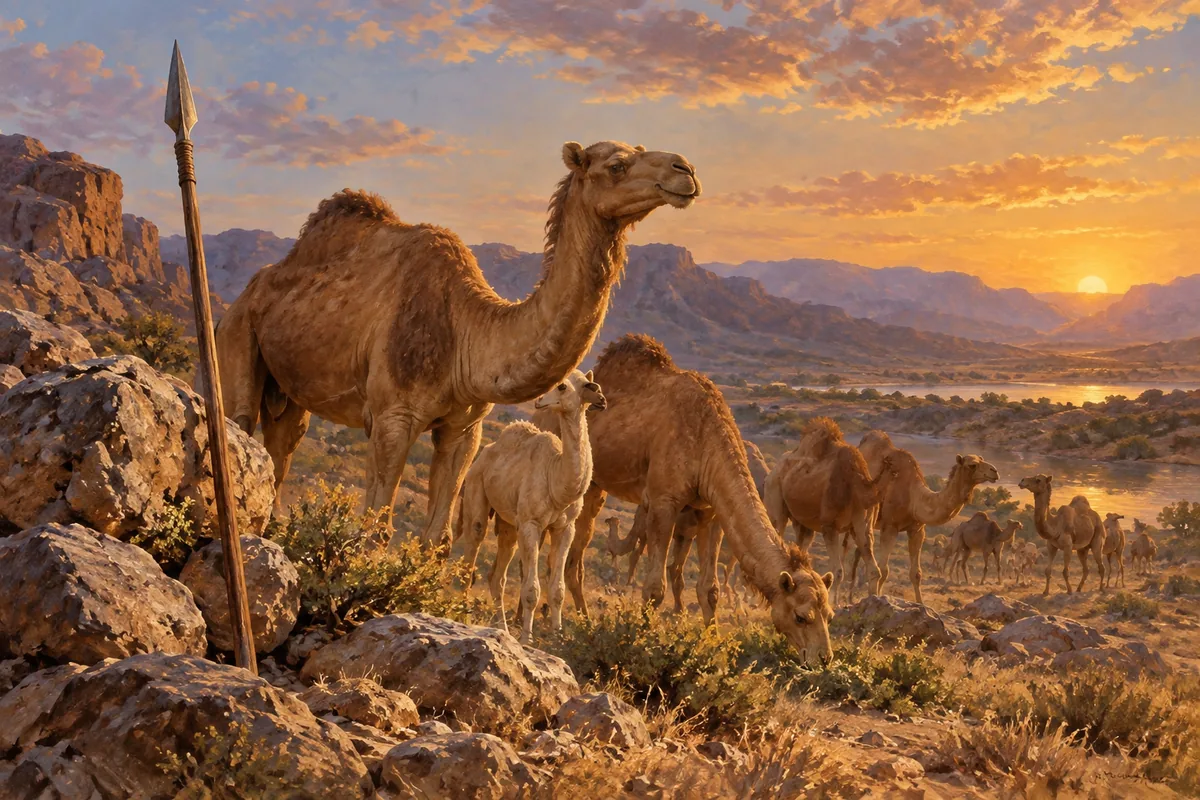
AI interpretation of Ba-Absini. An imaginary camel herd beside a simple spear resting upright, symbolic of Ba-Absini's attested peaceful camel tending and warrior role. NO real herder/dancer, ethnic costumes, ritual offerings, battle, stolen grain or health claim. Camel species and scenery imagined.
AI-generated unofficial original narrative interpretation. Selected scene: An imaginary camel herd beside a simple spear resting upright, symbolic of Ba-Absini's attested peaceful camel tending and warrior role. NO real herder/dancer, ethnic costumes, ritual offerings, battle, stolen grain or health claim. Camel species and scenery imagined. Fine anatomy, garments, objects and setting are modern AI imagined visual details, not an historical reconstruction, community portrait, authentic artifact or evidence of living practice.
Overview
Ba-Absini is identified as an Asben spirit welcomed among the warriors for his prowess, although the account also calls him a thief. In peaceful periods he tends camel herds. Health and bodily strength are attributed to his favor, with informants disagreeing over the appropriate fowl offering. His representation moves with a spear, thrusting at enemies in front of him; neither the beneficial claim nor the weapon performance supplies an independent medical result.
The song contrasts a saluting hand with a stealing foot and tells of taking grain even while being carried on his mother’s back. These are the spirit’s praise-story details. The later Musai notice on p. 364 places that spirit under his authority: Musai’s time in the ring is short because Ba-Absini takes over, and the song asks him to give up his mount. That specific hierarchy is retained without equating the named spirit with all people of Asben.
Origins & earliest records
A. J. N. Tremearne combines interviews and descriptions of bori performances with comparative interpretation. These selected notices do not consistently name individual speakers; printed attributes are distinguished from his conjectures.
Records & interpretation
Complete selected notice in chapter XXV, printed pp. 361–362; full chapter read.
Selected bibliography
Documented works and useful reading. This is not a list of every appearance.
- 01
The Ban of the Bori: Demons and Demon-Dancing in West and North Africa
Chapter XXV, printed pp. 361–362 (Ba-Absini) and 364 (Musai); complete spirit notices, song and attributed relationship.
Family & connections
A source-supported family tree or inspiration record has not yet been compiled for this profile. Related reading below indicates a connection in subject matter, not a proven lineage or creative influence.
References
Sources supporting this profile. Linked pages have their own scope and editorial standards.
- Digitized historical ethnographic accountTremearne — Ba-AbsiniResearch access: 2026-10-05
Image credits
AI-generated interpretationAI interpretation of Ba-Absini. An imaginary camel herd beside a simple spear resting upright, symbolic of Ba-Absini's attested peaceful camel tending and warrior role. NO real herder/dancer, ethnic costumes, ritual offerings, battle, stolen grain or health claim. Camel species and scenery imagined.
AI-generated unofficial original narrative interpretation. Selected scene: An imaginary camel herd beside a simple spear resting upright, symbolic of Ba-Absini's attested peaceful camel tending and warrior role. NO real herder/dancer, ethnic costumes, ritual offerings, battle, stolen grain or health claim. Camel species and scenery imagined. Fine anatomy, garments, objects and setting are modern AI imagined visual details, not an historical reconstruction, community portrait, authentic artifact or evidence of living practice.