
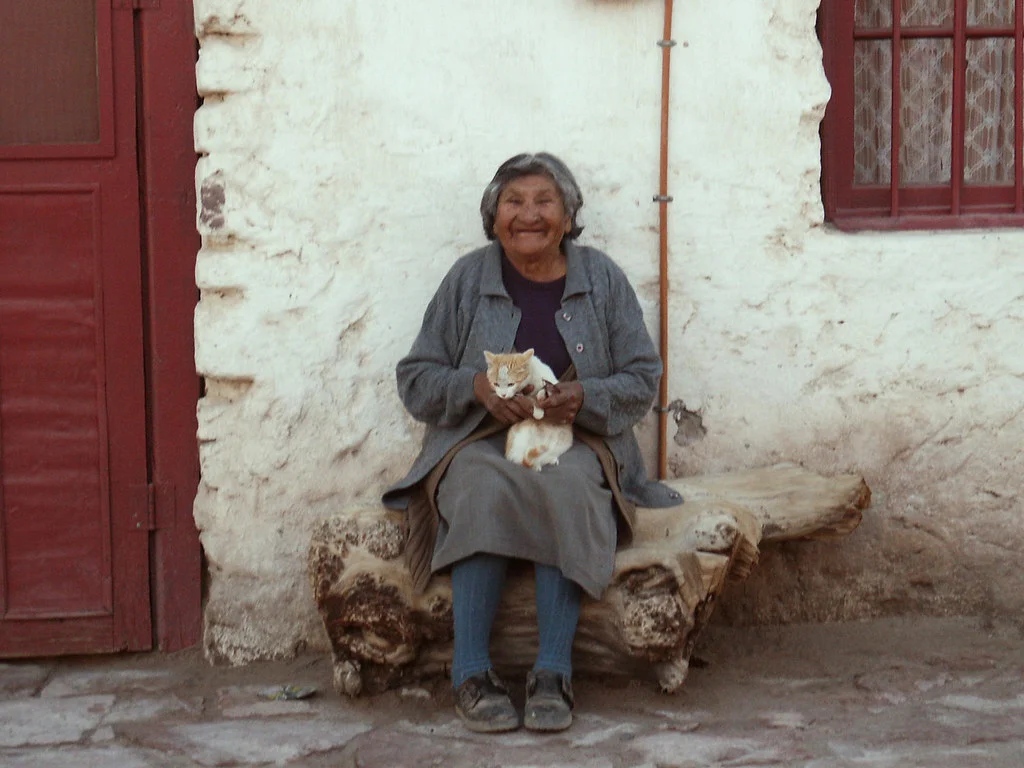
A woman identified by photographer Jose Manuel Podlech as Aymara, seated with a cat in Chiu Chiu, Chile, in 2004
Podlech identifies this sitter as an Aymara woman in Chiu Chiu, northern Chile. She is pictured holding a cat outside a building in 2004. The photograph records one person and locality; her appearance and clothing do not define all Aymara communities.
Overview
Aymara communities have longstanding presences across Peru, Bolivia and Chile; language use also extends beyond those principal areas. Peru’s Indigenous-peoples database describes rural communities alongside migration to cities including Lima, Arequipa and Tacna. Urban residence does not simply erase relationships with places of origin: celebrations, associations and commerce can sustain them. This entry therefore concerns a diverse living people, not an unchanged highland archaeological culture or one government representing every community.
The Peruvian account describes reciprocal labour, communal responsibilities and varied agricultural and pastoral livelihoods. It also distinguishes elected communal leadership from other local authorities and places institutions within histories of colonial administration, land loss and agrarian reform. These descriptions are geographically and historically situated. They cannot establish that every Aymara person holds land, occupies the same ceremonial role or speaks the language with equal fluency.
Chile’s heritage-language page provides a concrete example of contemporary authored transmission. Educator Iris Ramos Lázaro created the illustrated children’s collection Aymar Aru Yatixañani, presented in 2018, in Aymara with Spanish translations. The account connects her work with childhood memories, her family’s relationship to Cancosa and teaching in Cotasaya. Naming the author and educational setting distinguishes these modern works from anonymous ancient narratives. The page makes selected titles available, but the catalogue description used here is not a reading of every book. Different orthographic traditions also exist; spelling variation should be examined in its linguistic setting rather than treated as proof of separate biological populations.
A May 2026 UNESCO report describes two educational immersion gatherings in northern Chile: Putre in February and Camiña in May. Implemented with the Aymara consultancy Amtawi and the intercultural bilingual education program, the activities brought traditional educators together with speakers, elders and cultural practitioners. Food preparation, place-based vocabulary, music and community practices became settings for language use. The report is evidence of particular organized activities and of the organizers’ aims, not an independent demonstration that language decline has been reversed everywhere. Read alongside the named children’s literature and regionally specific institutional accounts, it shows cultural transmission as ongoing work by people in particular places. Nationality, community membership, language proficiency and cultural affiliation remain related but different questions.
History & identity
Andean community histories and modern cross-border presence; ancient political labels are not mapped automatically onto present identities.
Sources & representation
Selected Peruvian BDPI geographical/historical/institutional sections, complete Chilean language-resource page and complete UNESCO May2026 report. No population figures treated as current or linked children’s volumes claimed as fully read.
Selected bibliography
Documented works and useful reading. This is not a list of every appearance.
- 01
Aymar Aru Yatixañani
Collection presented in 2018 according to the Chilean heritage page; catalogue description used, not a complete reading of the 14 books.
- 02
El cactus que saluda
Selected undated official six-page PDF; no printed publication year.
Language & cultural connections
Source-supported language and cultural connections have not yet been compiled for this profile.
Located primary passages
Specific passages supporting details in this entry, grouped by their published witness.
Primary source witness
Selected undated official six-page PDF; no printed publication year.
- A child mistakes distant cacti for greeting people, then encounters a speaking vizcacha who corrects his understanding. The narrative places imaginative childhood learning in an Andean landscape. Its dedication identifies adapted stories for very young children and Indigenous-language educators. This is a named author’s pedagogical fiction, not zoological evidence for speaking animals or a universal Aymara belief.
Complete Spanish narrative, physical3–5; title1, project framing2 and dedication6.
Aymara text not independently translated or linguistically assessed. Other collection books unread; food-gathering instructions omitted. File creation/upload dates are not publication dates.
References
Sources supporting this profile. Linked pages have their own scope and editorial standards.
- Cultural institutionPeru BDPI:AimaraResearch access: 2026-10-05
- Cultural institutionChile heritage service:Lengua aymaraResearch access: 2026-10-05
- Cultural institutionUNESCO:language immersion in Putre and Camiña,15May2026Research access: 2026-10-05
Image credits
Contextual community portrait photographA woman identified by photographer Jose Manuel Podlech as Aymara, seated with a cat in Chiu Chiu, Chile, in 2004
Podlech identifies this sitter as an Aymara woman in Chiu Chiu, northern Chile. She is pictured holding a cat outside a building in 2004. The photograph records one person and locality; her appearance and clothing do not define all Aymara communities.