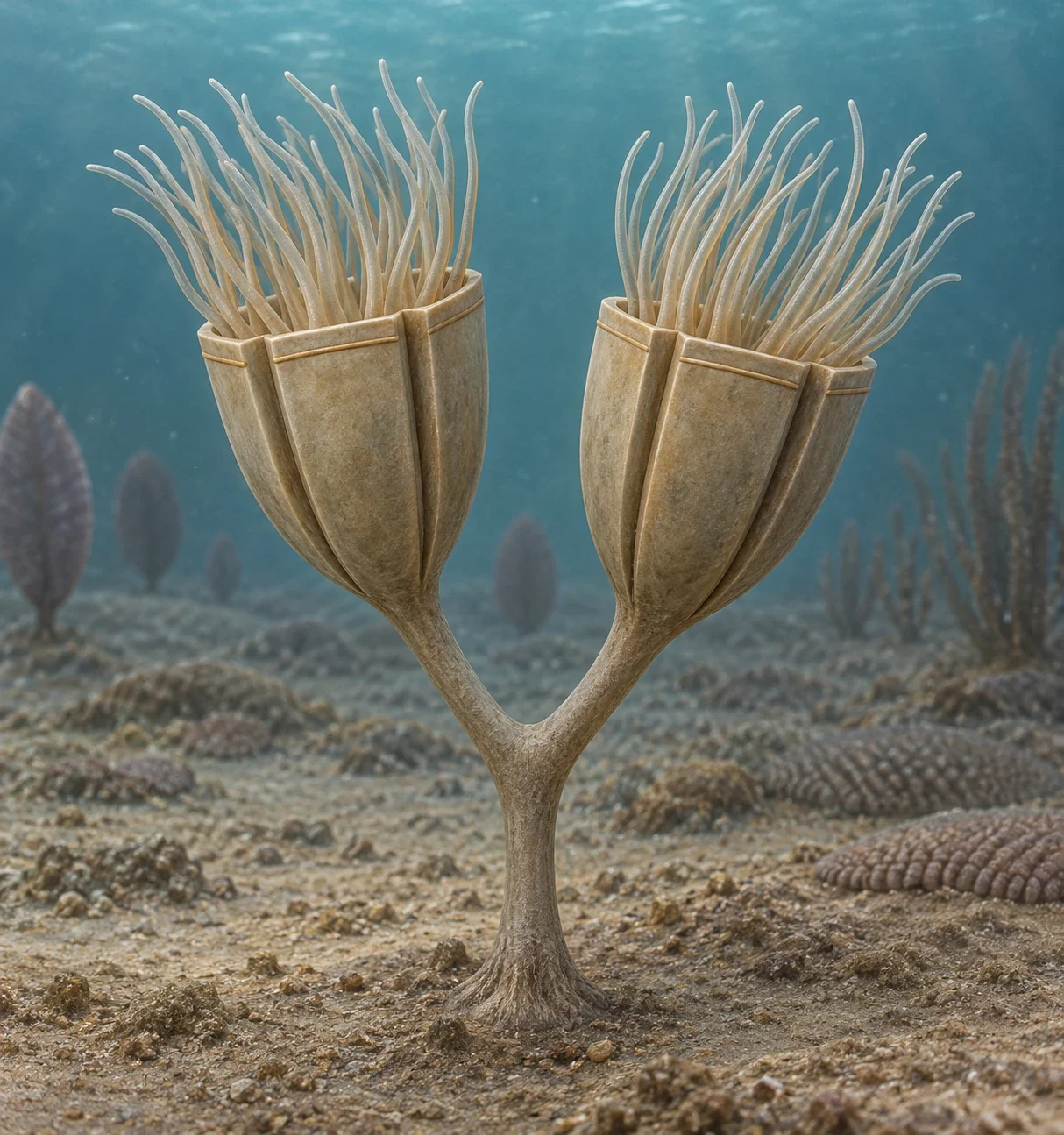
Auroralumina attenboroughii - AI-generated scientific interpretation.
Modern AI reconstruction of the two grooved organic cups and tentacles described by Dunn et al.2022. Colour, basal attachment and tentacle fine detail are hypothetical; not fossil evidence.
Overview
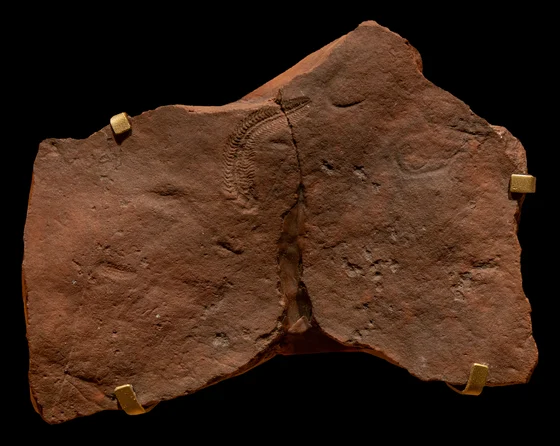
Auroralumina was described from a Charnwood Forest impression as two similarly sized, branching polyps enclosed in goblet-shaped cups. The cups have a polygonal outline and deep corner grooves. Softer tissue at their openings was interpreted as dense, simple tentacles rather than another rigid extension of the cup.
Dunn and colleagues compared preservation, form and anatomical characters to interpret the resistant walls as organic periderm surrounding cnidarian polyps. Their phylogenetic analysis placed the animal on the medusozoan stem within crown Cnidaria. This is a specific analytical result, not an inference that every Ediacaran tube belongs to the same phylum.
The geological account links an approximately 560-million-year age to zircon dating of surrounding rock. The animal predates the Cambrian diversification, showing that at least one recognizable animal body plan had appeared earlier. It does not date the first animal or prove that all modern cnidarian forms already existed.
Tentacles imply a food-capture role, but no meal or living feeding behaviour is preserved. Proposed planktonic prey remain ecological interpretations. The specimen’s base is missing or obscured, so a reconstructed holdfast and colours must be labelled hypothetical. Naming it for David Attenborough commemorates public awareness of the fossils and adds no anatomical evidence.
Origins & earliest records
Dunn and colleagues named the genus and species in 2022. The holotype remains in the field, while casts and imaging allow study; its approximately 557–562 Ma context belongs to the Ediacaran.
Evidence & interpretation
Fossil relief, cast inspection, imaging and character-based comparison support the polyp interpretation. Rock dating constrains geological age. Phylogenetic position, tentacle function and ecological details remain inferences with different levels of confidence.
Selected bibliography
Documented works and useful reading. This is not a list of every appearance.
- 01
A crown-group cnidarian from the Ediacaran of Charnwood Forest, UK
Selected bibliography; bounded source account, not exhaustive coverage.
- 02
560-million-year-old fossil is first animal predator
Selected bibliography; bounded source account, not exhaustive coverage.
Family, evolution & connections
Taxonomic classification
A hierarchy of classified groups, not a chain of direct ancestors.
Source note: Stem-medusozoan and crown-cnidarian placements follow the 2022 analysis; these nested statements are compatible. No living cnidarian class is forced.
- kingdomAnimalia
- phylumCnidaria
- cladeMedusozoa stem group
- genusAuroralumina
- speciesAuroralumina attenboroughii
References
Sources supporting this profile. Linked pages have their own scope and editorial standards.
- InstitutionalA crown-group cnidarian from the Ediacaran of Charnwood Forest, UKResearch access: 2026-10-10
- Institutional560-million-year-old fossil is first animal predatorResearch access: 2026-10-10
Image credits
AI-generated scientific interpretationAuroralumina attenboroughii - AI-generated scientific interpretation.
Modern AI reconstruction of the two grooved organic cups and tentacles described by Dunn et al.2022. Colour, basal attachment and tentacle fine detail are hypothetical; not fossil evidence.