
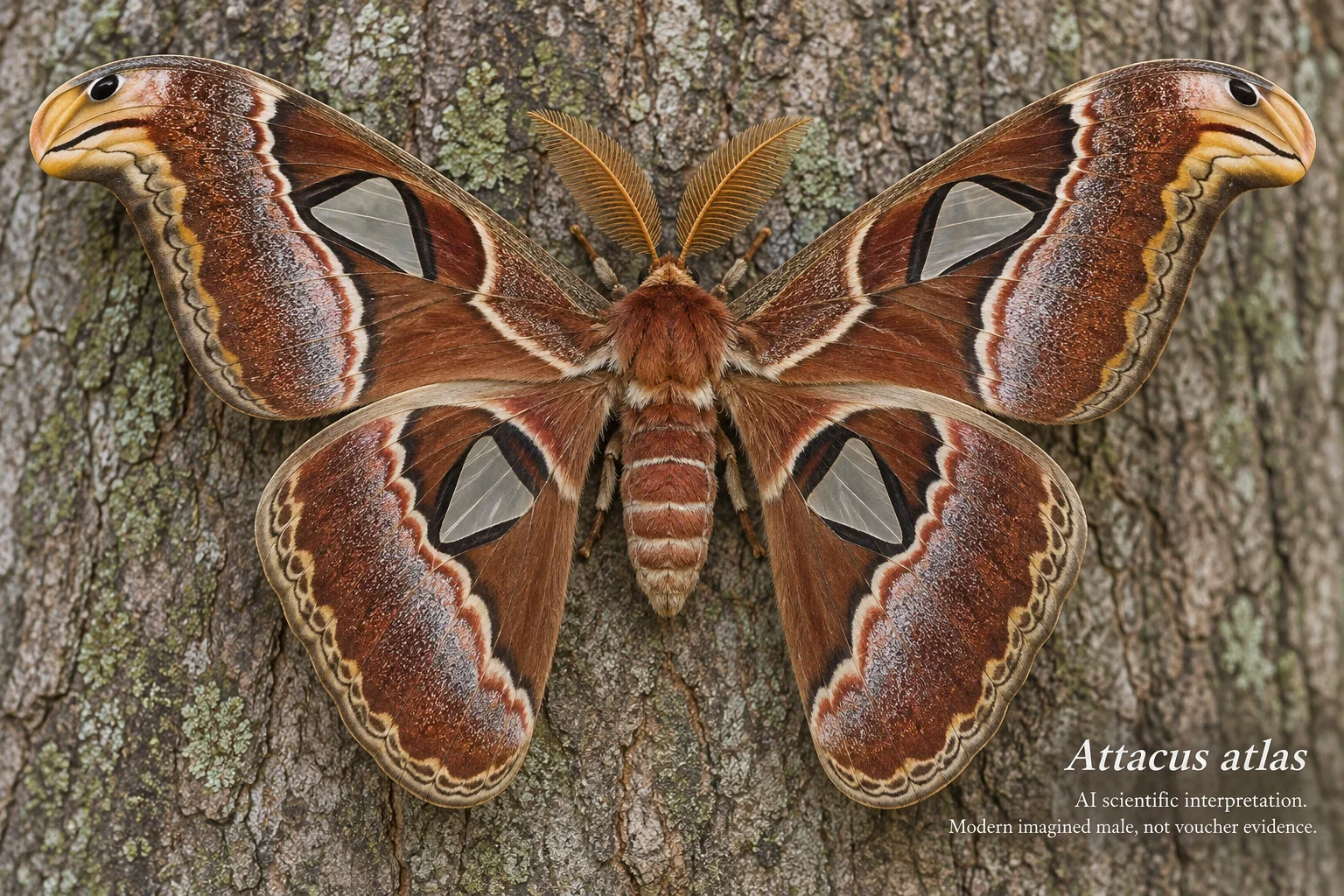
AI scientific interpretation of Attacus atlas.
AI scientific interpretation of an imagined Attacus atlas.
Overview
Malaysia’s biodiversity account describes brown wings with coloured accents, hooked forewing tips and black-bordered triangular translucent patches on both forewings and hindwings. The body is small relative to the wings. Males have longer, more feathery antennae than females; the illustration therefore selects a male.
Florida Museum places the species in Saturniidae and explains that adults do not feed: the proboscis is undeveloped, and stored larval energy supports a short reproductive life. Female pheromones attract males whose comb-shaped antennae carry receptors. Its account cautions that proposed snake-head mimicry has not been experimentally tested.
The Paris museum describes tropical Asian forests, red-brown wing colours and blue-green caterpillars exceeding ten centimetres. It reports about one week of adult life and polyphagous larvae able to develop on many plant species. These stage-specific observations distinguish a feeding larva from the non-feeding adult.
Origins & earliest records
Government biodiversity and museum accounts distinguish diagnostic appearance, development and proposed defence.
Evidence & interpretation
Snake-like forewing tips are a morphological comparison, not proof of an established defensive mechanism.
Selected bibliography
Documented works and useful reading. This is not a list of every appearance.
- 01
- 02
- 03
Family, evolution & connections
Taxonomic classification
A hierarchy of classified groups, not a chain of direct ancestors.
Source note: Florida Museum identifies a saturniid; external similarity alone does not resolve every Attacus species.
- FamilySaturniidae
References
Sources supporting this profile. Linked pages have their own scope and editorial standards.
- Government biodiversityAttacus atlas – Atlas MothResearch access: 2026-10-11
- Museum natural historyAtlas Moths at the McGuire CenterResearch access: 2026-10-11
- Museum natural historyPapillon AtlasResearch access: 2026-10-11
Image credits
AI-generated interpretationAI scientific interpretation of Attacus atlas.
AI scientific interpretation of an imagined Attacus atlas.