
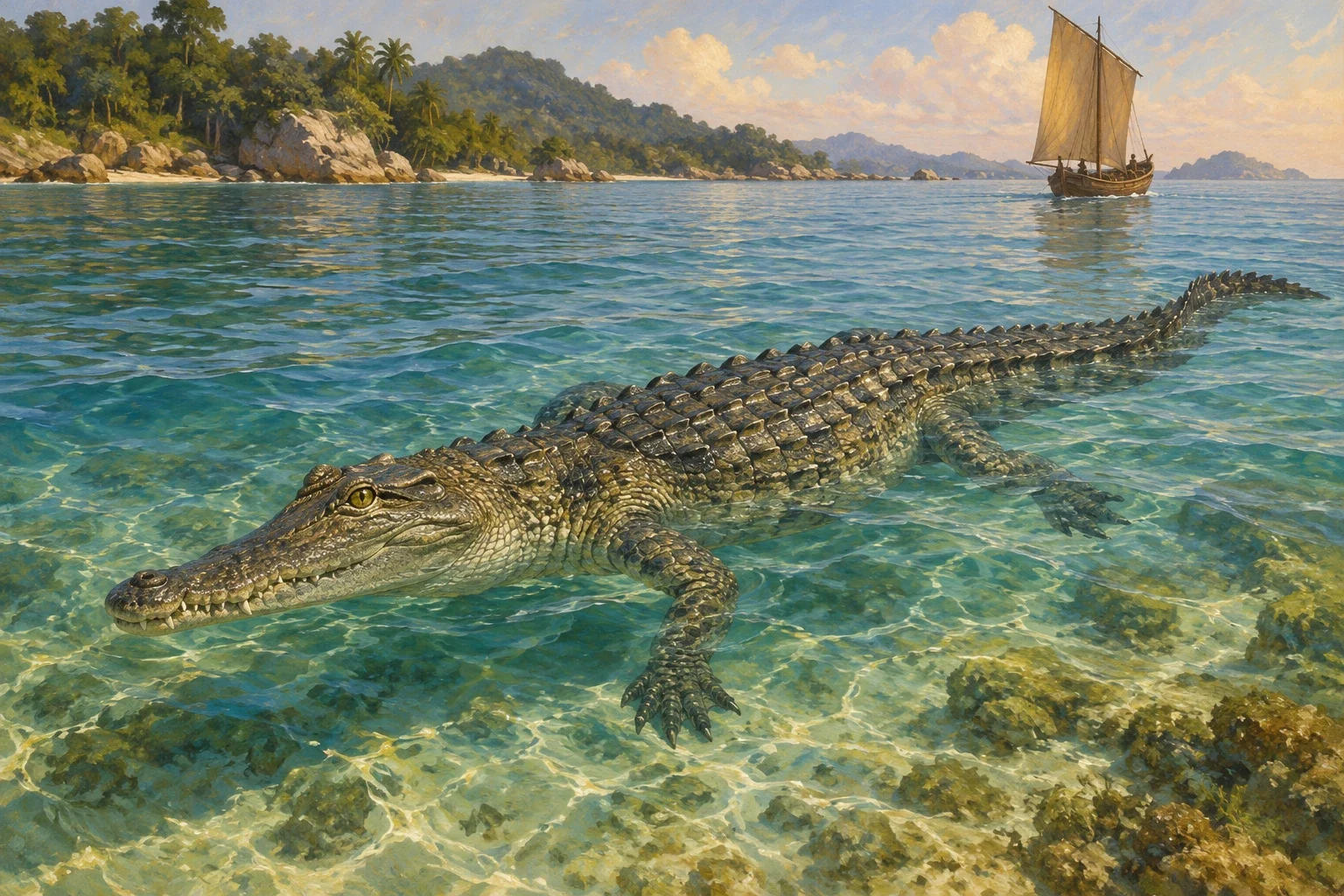
AI-generated narrative interpretation of Atonn in Pavie’s 1903 French abridgment.
Species, proportions, colouring, boat and coast are imagined. The picture does not establish precise pursuit direction or zoological identity.
Overview
Atonn is the named crocodile in the story of Néang Roum-Say-Sock that Auguste Pavie publishes in 1903. Pavie places his encounter with the tale at Teucthio, north of Battambang, in a Cambodian region he describes as then under Siamese rule. His elderly guide explains that he has read the story and offers a short abridgment. This is therefore a collector’s literary presentation of an already circulating narrative, rather than a complete native-language transcript or an account attributable to a named author.
The crocodile belongs to the episode of Réachkol’s two marriages. Leaving Roum-Say-Sock at home, Réachkol travels to Korat and marries Néang Mika, the king’s daughter, while concealing his earlier marriage until afterward. When he eventually sails away, Mika sees that his ship has turned toward his first wife. She commands Atonn, whom she has fed since childhood, to pursue and devour him. The animal’s attachment is thus to a particular feeder and mistress; the narrative does not describe a general covenant between all crocodiles and people.
Réachkol appeals to Atonn to recognize him as its mistress’s husband. The crocodile answers that it obeys the woman who feeds it and knows only her. The sailors abandon the small boats they are towing, then throw cages of chickens and ducks into the water, hoping to delay their pursuer. These efforts fail and anger Atonn. Roum-Say-Sock, watching from the shore, sees the crocodile in the ship’s wake while the crew scrambles in alarm. The animal is close enough that one more leap would reach the vessel.
Roum-Say-Sock removes the precious hairpin given by her adoptive hermit father and throws it toward the danger. It falls into the sea in front of her; when its point touches the seabed, the land rises and drives away the water. The ship is stranded on rock and Réachkol runs to safety. Atonn lies on another mound and dies, calling on its mistress to avenge it. The text uses the word foudroyé, but does not describe a visible lightning bolt or the hairpin physically striking the crocodile. A later exchange links the crocodile and ship to named hills; this is the story’s landscape explanation, not evidence of a real animal transformed into stone.
Mika’s subsequent campaign and the conflict between the two wives continue the legend after Atonn’s death. The complete chapter also includes Pavie’s later visits to ruins and a separate feared guardian-snake encounter. That snake is not Atonn, and the collector’s assertions about religion, geology and zoology are not adopted here. This profile concerns Atonn in Pavie’s particular French presentation; it does not identify a biological species, establish the tale’s geology, or represent every Khmer crocodile tradition.
Origins & earliest records
Chapter I, Néang Roum-Say-Sock, in Auguste Pavie’s 1903 Contes populaires du Cambodge, du Laos et du Siam; an unnamed elderly guide at Teucthio offers an abridgment of a book he had read.
Records & interpretation
Complete chapter I, pp. 25–47; Atonn’s command, speech, pursuit and death on pp. 31–33, with the guide’s explicit abridgment statement on p. 28.
Selected bibliography
Documented works and useful reading. This is not a list of every appearance.
- 01
Contes populaires du Cambodge, du Laos et du Siam
I, Néang Roum-Say-Sock, pp. 25–47; central Atonn episode pp. 31–33; complete introduction pp. 1–24.
Family & connections
A source-supported family tree or inspiration record has not yet been compiled for this profile. Related reading below indicates a connection in subject matter, not a proven lineage or creative influence.
References
Sources supporting this profile. Linked pages have their own scope and editorial standards.
- Historical collector’s literary abridgments and attributed narrative framingPavie: original French collection, complete chapters I–II and introductionResearch access: 2026-10-21
Image credits
AI-generatedAI-generated narrative interpretation of Atonn in Pavie’s 1903 French abridgment.
Species, proportions, colouring, boat and coast are imagined. The picture does not establish precise pursuit direction or zoological identity.