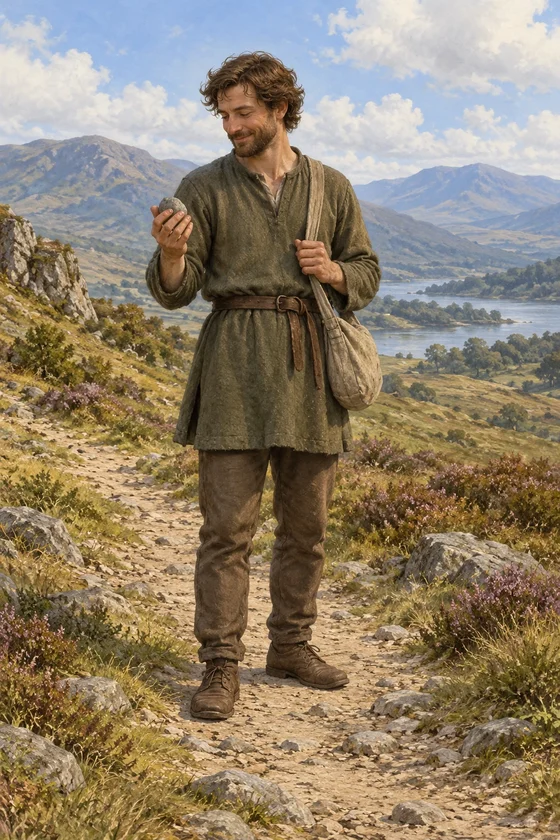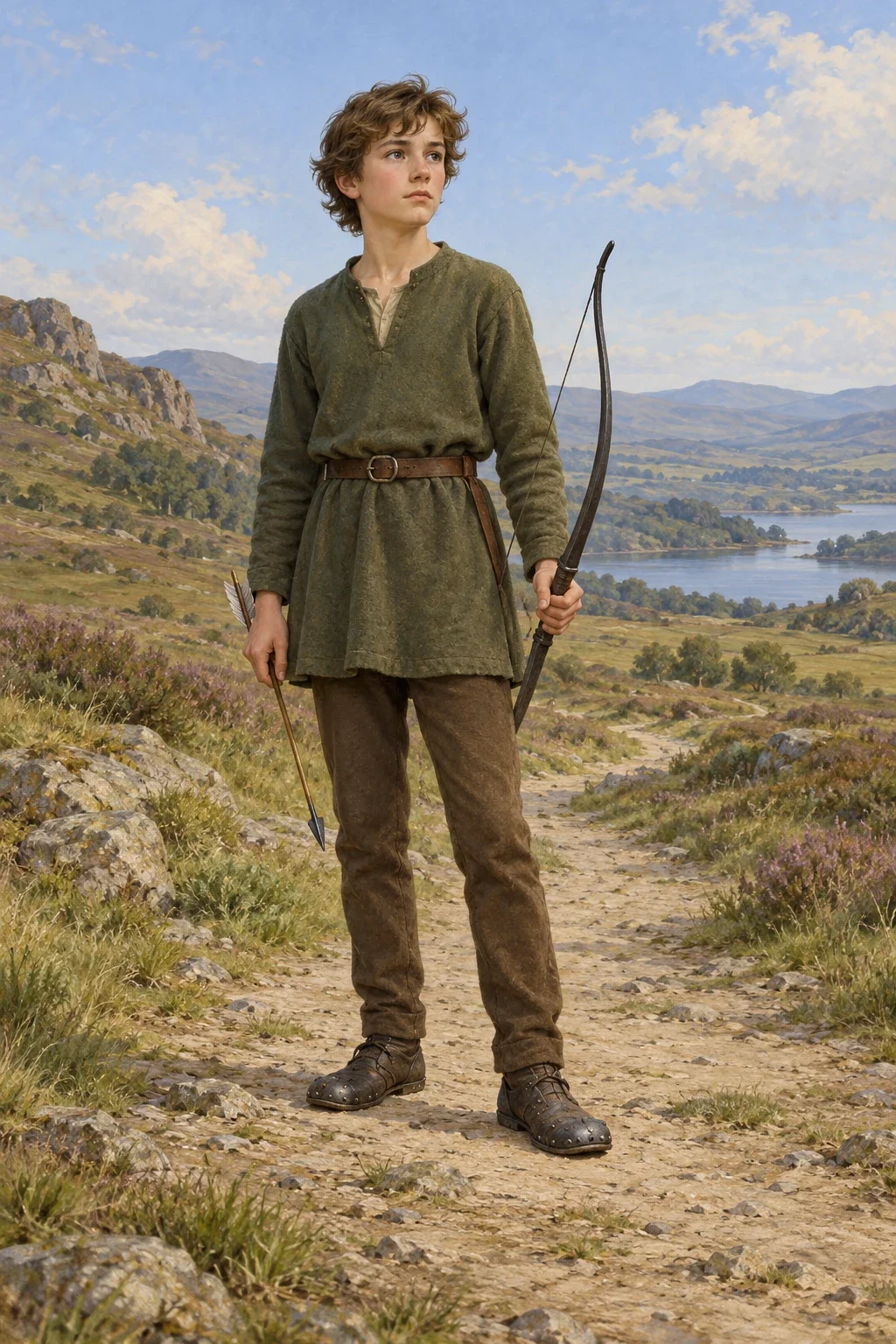
Portrayal of Asphurtzela (Wardrop’s Version).
Portrayal selects the youthful human rescuer on his first quest with iron shoes and bow, before the devi encounter. Exact age, face, colours and practical clothing are imagined; no monster, violence, uprooted tree or later injury is combined into that moment.
Overview
Asphurtzela is the youngest son in Wardrop’s Georgian tale XII. After a hundred-headed devi takes the older children, a stranger gives their grieving mother an apple and tells her to cut it into a hundred pieces, eating three each day. On finishing it she bears Asphurtzela, who grows as much in a day as other children do in a year. Wardrop’s note glosses his name as “hundred leaves” and connects it with his birth. The narrative nevertheless calls him a boy when he reaches the devi’s house. It does not give a numerical age or describe his face, hair or clothing. His later marriage does not supply an ordinary age chronology for this miraculously growing figure.
Learning of his siblings, he frightens ploughmen away, takes their iron plough to a smith and has it made into shoes and a bow and arrow. He crosses the stream outside the devi’s house and identifies himself to his sister. Unlike his intimidated brothers, he demands meat, a large wine measure and a bed. He substitutes a log for himself when his host tries to kill him at night. In their wrestling contest he drives the devi into the ground, retrieves his dead brothers from a coffer inside its body and revives them with the accompanying handkerchief. He then kills the devi and its mother.
His restored brothers repay him by binding him to a tree. After a prayer he uproots it and makes them release him, then leaves home. He joins a clod-swallower and a runner who catches hares while wearing mill wheels. Another adventure brings three captive maidens within reach, but these companions abandon him underground after he has sent the women up. Ignoring the youngest maiden’s warning, he enters the black rather than white stream and reaches the lower regions.
There he kills the dragon withholding the inhabitants’ water and saves their princess, but refuses a royal marriage because he wants to return to the land of light. He also saves a griffin’s nestlings from another dragon. Their mother carries him upward in gratitude; when provisions fail he feeds her flesh from his own leg, which she later restores. Back above, he kills the treacherous companions, marries the youngest rescued maiden and gives the others to his brothers. These successive rescues, betrayals and exchanges belong to this one narrative; Wardrop’s comparative references do not supply additional episodes or turn him into a generic Georgian national hero. The opening gives three older brothers, while the ending assigns two elder maidens to brothers without reconciling that count; the discrepancy is retained.
Origins & earliest records
Complete Part I, XII, Asphurtzela, printed pp. 68-83, in Marjory Wardrop’s Georgian Folk Tales (1894). Her preface identifies Part I’s source as Aghniashvili’s Khalkhuri Zghaprebi, Tiflis, 1891.
Records & interpretation
Complete selected English tale, all its notes, and complete preface read from retained original-edition transcription. The earlier Georgian source was not independently consulted; no physical-page or contemporary belief claim.
Selected bibliography
Documented works and useful reading. This is not a list of every appearance.
- 01
Georgian Folk Tales
Part I, XII, Asphurtzela, pp. 68-83; selected complete historical English narrative and notes, with source attribution from the full preface.
Family & connections
A source-supported family tree or inspiration record has not yet been compiled for this profile. Related reading below indicates a connection in subject matter, not a proven lineage or creative influence.
References
Sources supporting this profile. Linked pages have their own scope and editorial standards.
- Primary historical folklore translationWardrop, Georgian Folk Tales, retained original English edition transcriptionResearch access: 2026-10-18
Image credits
AI-generatedPortrayal of Asphurtzela (Wardrop’s Version).
Portrayal selects the youthful human rescuer on his first quest with iron shoes and bow, before the devi encounter. Exact age, face, colours and practical clothing are imagined; no monster, violence, uprooted tree or later injury is combined into that moment.