
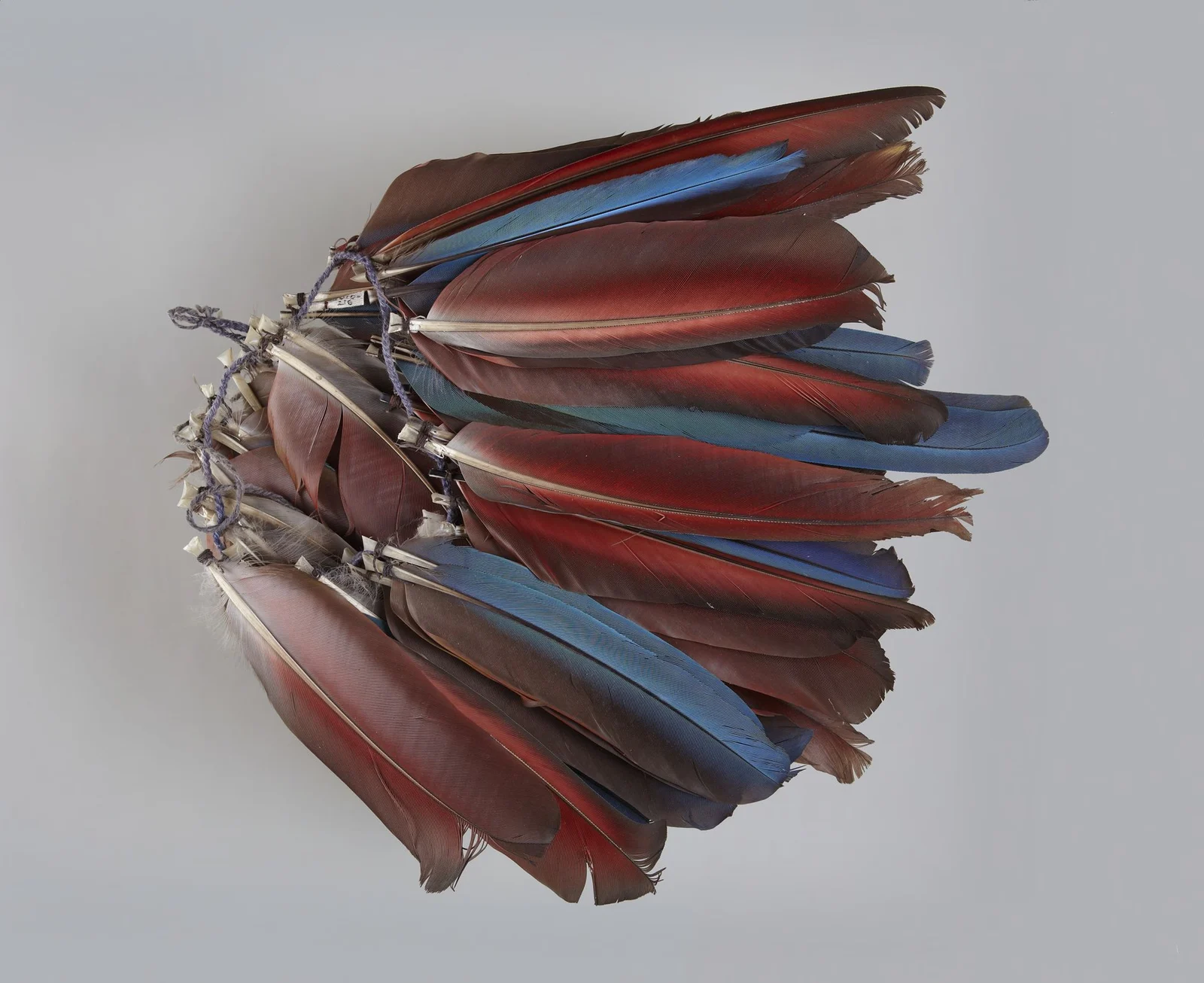
A feather ornament lies on a gray surface, with long red-brown and blue feathers tied together at their shafts with visible cord.
Feather ornament from Peru’s Montaña region, dated 1960–1975 and catalogued by Princeton as Asháninka, also using the older term Campa. The catalogue names no individual maker. This particular object does not establish universal dress or ceremonial use.
Overview
Ashaninka communities occupy a broad region of the Peruvian Amazon and also live in Brazil. Peru’s cultural database describes communities along rivers including the Perené, Ene, Tambo and Ucayali, while recognizing regional differences. Its language entry places Ashaninka in the Arawak family. Linguistic relationship is not a biological category, and the separately identified Asheninka should not automatically be treated as a spelling variant that erases their own identity. Broad geographical descriptions also do not mean that one association speaks for every settlement.
The language entry distinguishes varieties associated with Alto Perené and with Ene, Tambo and Satipo. Drawing on education-ministry assessments from 2013 and 2018, it reports different levels of transmission across these areas. Those dated assessments are not a fresh census. The same account describes a standardized alphabet developed with community representatives and used in intercultural bilingual materials. A common writing system can support education without making every regional pronunciation, learning experience or language history identical.
The Apiwtxa association offers a specifically Brazilian community account. In a 2015 statement, it describes the Rio Amônia community’s struggle for territorial recognition, achieved in 1992, and the creation of its association and Ayõpare cooperative. Men and women participate in collective leadership and consultation. The statement connects territorial planning with food production, forest recovery and education, and describes renewed ties with Ashaninka organizations in Peru. These are locally situated institutional experiences, not a template imposed on the whole people.
Benki Piyãko’s December 2007 message supplies a named participant’s perspective. He dates the opening of the Yorenka Ãtame centre to 7 July that year and describes its aims: exchanging community and academic knowledge, restoring forests, and training Indigenous and non-Indigenous young people. His account includes digital communication and environmental work together. It therefore presents cultural continuity as active learning and collaboration, rather than withdrawal from contemporary technology.
Art and publishing provide another form of transmission. A Peruvian ministry notice of May 2018 introduces Imagen y palabra asháninka, with narratives gathered by Javier Macera and illustrations by Ashaninka artist and narrator Wilberto Casanto. It describes the images and words as a selection from a much larger oral tradition. This is a bibliographic reference to that publication and its named contributors; neither the complete book nor all regional traditions have been examined here.
History & identity
Regional histories and collective identities are distinguished from modern association dates and broad linguistic classifications.
Sources & representation
Selected BDPI people introduction and complete language body; complete Apiwtxa 2015 statement and Benki2007 message; complete ministry publication notice. Linked books and audio uninspected.
Selected bibliography
Documented works and useful reading. This is not a list of every appearance.
- 01
Imagen y palabra asháninka
Ministry presentation notice dated23May2018; bibliography only, not full-book reading.
Language & cultural connections
Source-supported language and cultural connections have not yet been compiled for this profile.
References
Sources supporting this profile. Linked pages have their own scope and editorial standards.
- Government cultural databaseBDPI: Ashaninka peopleResearch access: 2026-10-05
- Government language databaseBDPI: Ashaninka languageResearch access: 2026-10-05
- Community organizationApiwtxa: community communications,2015Research access: 2026-10-05
- Community-authored statementBenki Piyãko: Yorenka Ãtame,2007Research access: 2026-10-05
- Publication noticeMinistry of Culture: Imagen y palabraResearch access: 2026-10-05
Image credits
Museum photograph of a specifically catalogued Asháninka featherwork objectA feather ornament lies on a gray surface, with long red-brown and blue feathers tied together at their shafts with visible cord.
Feather ornament from Peru’s Montaña region, dated 1960–1975 and catalogued by Princeton as Asháninka, also using the older term Campa. The catalogue names no individual maker. This particular object does not establish universal dress or ceremonial use.