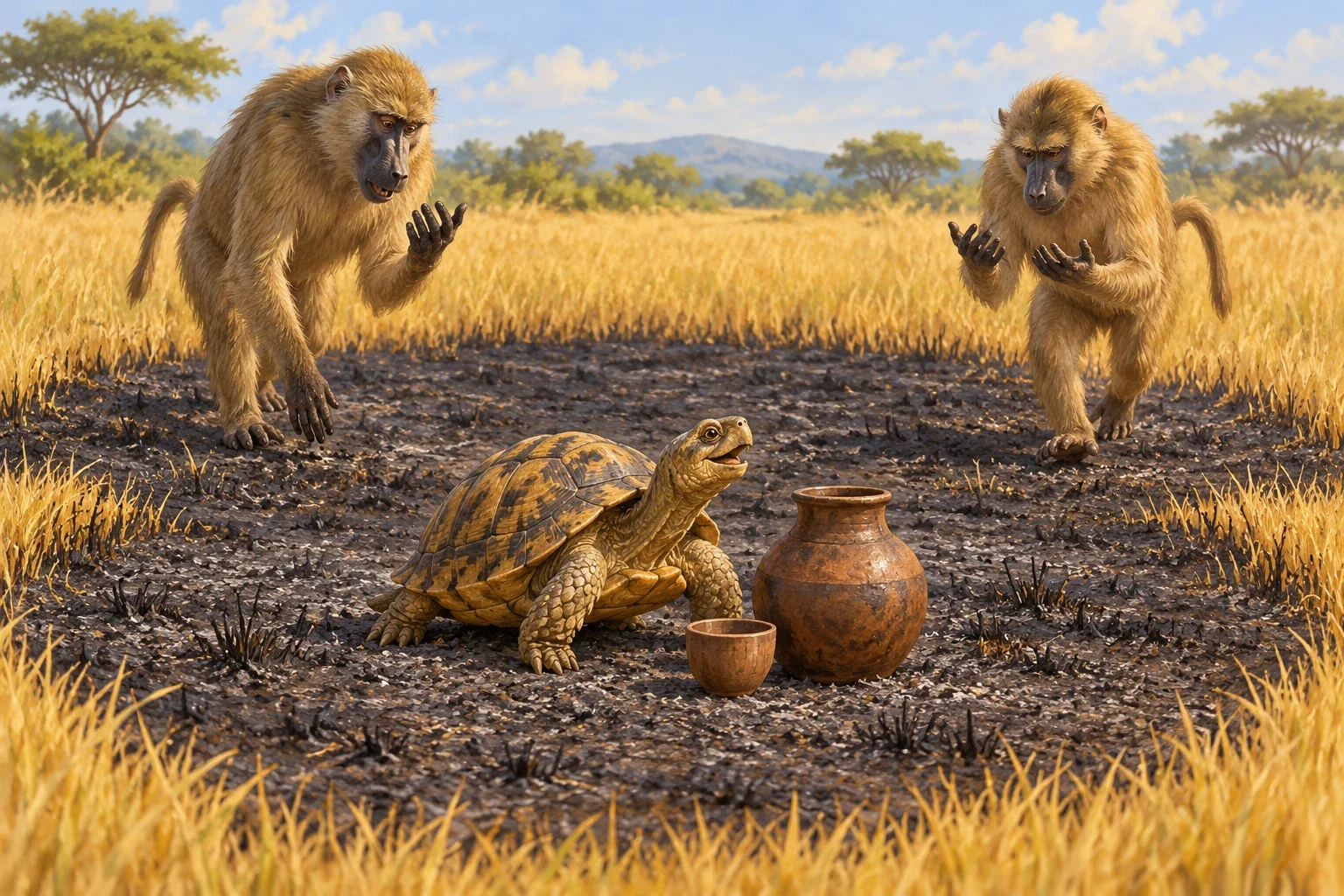
AI-generated interpretation of the tortoise’s ash-covered beer feast in Rattray’s Chinyanja fableXXII.
The ash, drinking cup and frustrated baboons follow the fable. Exact animal species, vessel forms, landscape and count of baboons beyond plural are illustrative choices.
Overview
R. Sutherland Rattray’s fable XXII, Kamba ndi Nyani, begins with a tortoise and a baboon making a covenant of friendship. The baboon invites the tortoise to drink beer at his home. When the tortoise arrives, the baboons have carried their beer into a tree. They insist that they never drink on the ground and invite him to climb. He repeatedly slips and finally gives up. Their invitation offers hospitality in words while making access depend on a bodily ability he lacks.
The tortoise then prepares beer at his own home and summons the baboons. He burns a patch of grass, places the beer in its centre and carefully washes the drinking cup. When his guests arrive, they walk across the burned ground. He tells them that the cup belongs to someone else and must not be touched with dirty hands. They go away to wash, but every return brings them across the burned patch again. The tortoise ends by repeating the substance of their earlier taunt: leaving without a drink is supposedly their own fault. The fable stops with this reciprocal exclusion rather than describing a reconciliation, injury or magical punishment.
This is a particular talking-animal episode, not a claim that every tortoise in Rattray’s collection is one continuous named individual. The already represented relay-race tortoise has a different plot and opponent. Here the animal uses an arranged environment and a rule about cleanliness to turn the baboons’ own hospitality against them. No transformation, supernatural speed or weapon is attributed to him. The text identifies ordinary tortoise and baboon forms without assigning a biological species.
Rattray prints the complete Chinyanja original at pages 64–65, his literal English translation at pages 145–146, and twelve numbered language notes. The running heads on pages 65 and 146 name the following fable; XXII continues above its separate XXIII heading. Rattray’s preface locates his collection among people of Central Angoniland, while Alexander Hetherwick describes his work around Blantyre and the broader use of Nyanja in Nyasaland. These are collection and language contexts, not proof of this fable’s exclusive modern national origin. No individual teller is named for XXII. The colonial prefaces’ broad claims about African minds and cultural disappearance are not adopted as facts about contemporary communities.
Origins & earliest records
Fable XXII in Rattray’s Chinyanja collection (1907), original pp.64–65 and English pp.145–146; individual teller unnamed.
Records & interpretation
Complete original64–65, literal English145–146, all12 local notes; both complete prefaces v–ix read.
Selected bibliography
Documented works and useful reading. This is not a list of every appearance.
- 01
Some Folk-Lore Stories and Songs in Chinyanja, with English Translation and Notes — XXII Kamba ndi Nyani
Complete original64–65, literal English145–146, all12 local notes; both complete prefaces v–ix read.
Family & connections
A source-supported family tree or inspiration record has not yet been compiled for this profile. Related reading below indicates a connection in subject matter, not a proven lineage or creative influence.
References
Sources supporting this profile. Linked pages have their own scope and editorial standards.
- ReferenceRattray1907, fableXXII, complete original and literal translationResearch access: 2026-10-21
Image credits
AI-generatedAI-generated interpretation of the tortoise’s ash-covered beer feast in Rattray’s Chinyanja fableXXII.
The ash, drinking cup and frustrated baboons follow the fable. Exact animal species, vessel forms, landscape and count of baboons beyond plural are illustrative choices.