
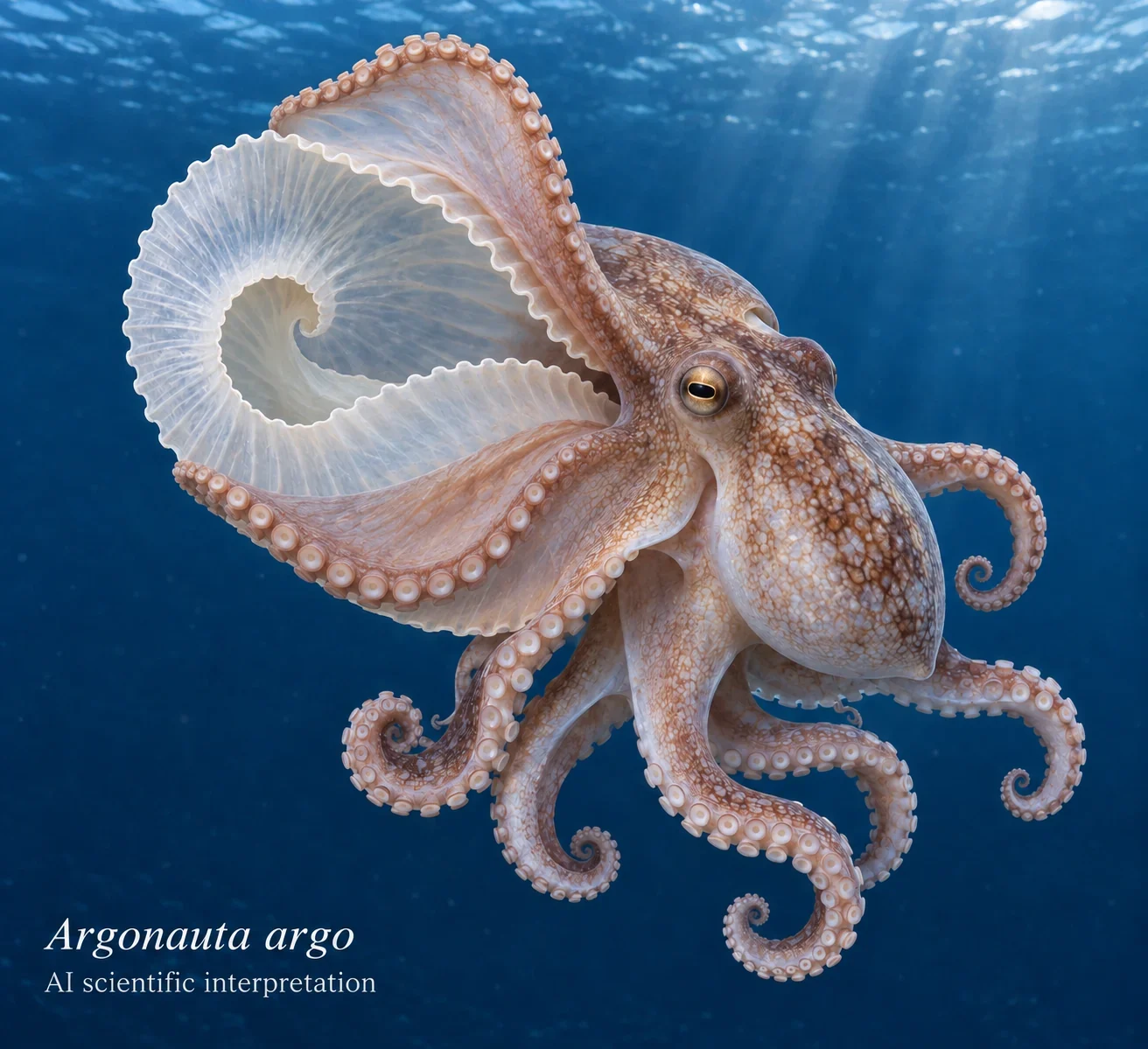
AI scientific interpretation of Argonauta argo.
AI scientific interpretation of an imagined Argonauta argo.
Overview
Natural History Museum identifies the greater argonaut as the largest living paper nautilus, occurring in oceans worldwide. Only females make the thin spiralling calcium-carbonate eggcase. Unlike a true mollusc shell secreted by the mantle, it is produced by specialised arm tissue; the animal is not permanently attached to it.
Finn and Norman’s 2010 research describes females capturing air at the sea surface, sealing it with their arms and diving until compressed gas offsets body weight. The eggcase therefore functions as a hydrostatic structure as well as a brood chamber. This is active control of buoyancy rather than accidental trapping of air.
The study collected three female Argonauta argo off Japan’s Shimane Peninsula in January 2006 and observed manipulated releases in Okidomari Harbour. Its discussion contrasts the open, unchambered eggcase with the chambered nautilus shell, interpreting their use of gas as evolutionary convergence. It leaves the selective origins of pelagic life unresolved.
Origins & earliest records
Museum anatomical interpretation complements direct observations and manipulations of live females.
Evidence & interpretation
The small field sample and uncertain evolutionary context remain explicit.
Selected bibliography
Documented works and useful reading. This is not a list of every appearance.
- 01
- 02
Family, evolution & connections
Taxonomic classification
A hierarchy of classified groups, not a chain of direct ancestors.
Source note: The study places argonauts in Argonautidae; convergence does not make them close nautilus relatives.
- FamilyArgonautidae
References
Sources supporting this profile. Linked pages have their own scope and editorial standards.
- Museum natural historyArgonauts: Are these the world’s weirdest octopuses?Research access: 2026-10-11
- Retained native indexed primary textThe argonaut shell: gas-mediated buoyancy control in a pelagic octopusResearch access: 2026-10-11
Image credits
AI-generated interpretationAI scientific interpretation of Argonauta argo.
AI scientific interpretation of an imagined Argonauta argo.