
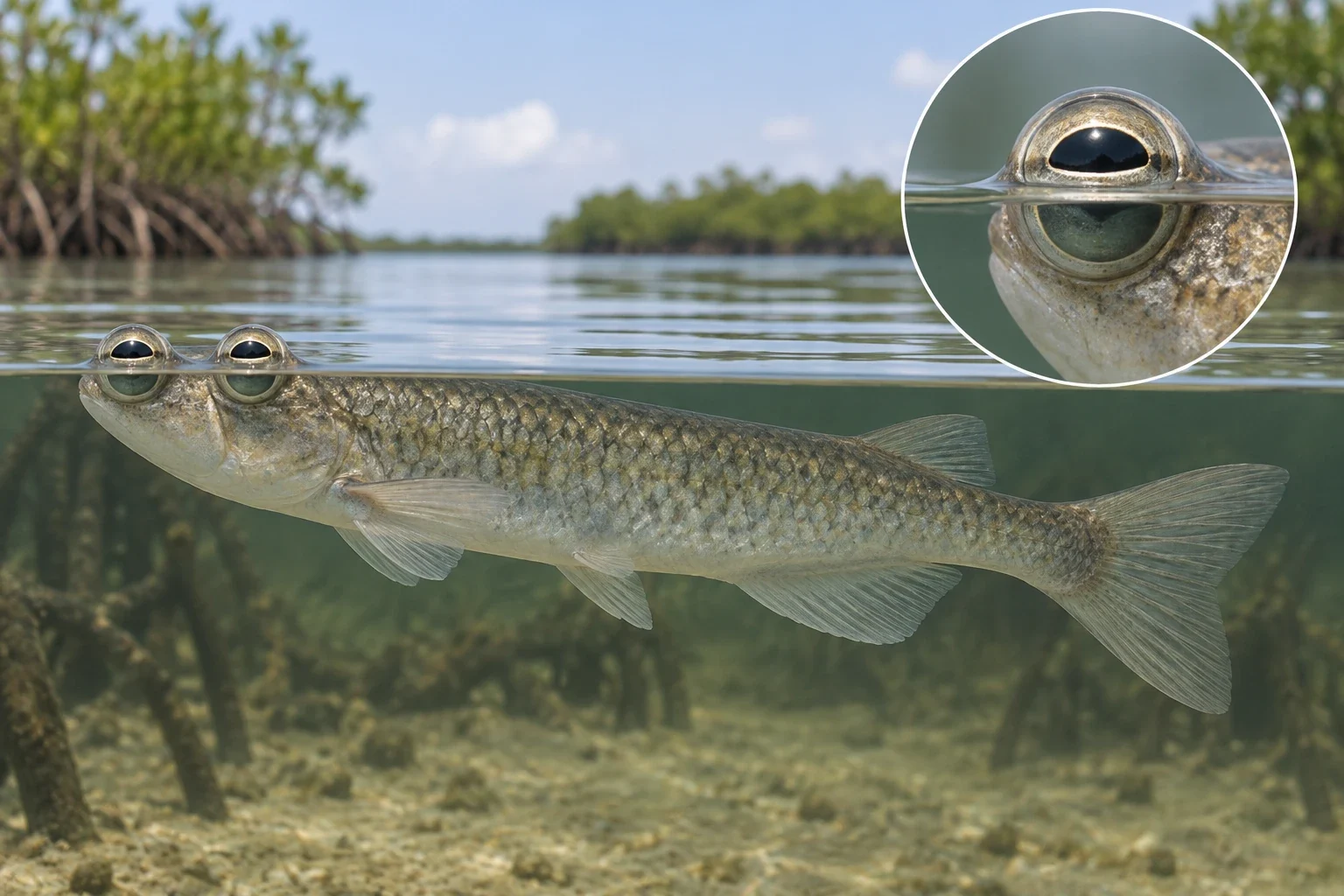
Modern AI interpretation of a surface-swimming fish.
Modern AI interpretation; eye arrangement schematic, body colour and habitat staging imagined.
Overview
Anableps anableps has two eyes, despite its four-eyed nickname. The California Academy describes each bulging eye divided by a thin tissue band into upper and lower sections, each with a cornea and pupil. At the surface this arrangement admits light from both air and water; it is not four independent eyeballs.
The Academy places the species along Trinidad and northern South America, in brackish mangrove estuaries and some freshwater channels. It describes movements into flooded mangroves at high tide and retreat into permanent channels as water recedes. These habitat observations explain the surface setting without proving a complete distribution or one invariant feeding schedule.
Avery and Bowmaker’s 1982 study measured photoreceptor absorbance in dorsal and ventral retinal regions. Their abstract reports the same visual pigments in both regions, despite predictions of stronger red dominance in the aquatic field. Optical partitioning therefore does not by itself establish different pigment inventories. The experiment addresses a particular physiological question, not every aspect of vision or its developmental origin.
Origins & earliest records
The accepted name carries Linnaeus’s 1758 authority; visual adaptation is a separate evolutionary question.
Evidence & interpretation
Retained scientific and institutional passages.
Selected bibliography
Documented works and useful reading. This is not a list of every appearance.
- 01
- 02
- 03
Family & connections
A source-supported family tree or inspiration record has not yet been compiled for this profile. Related reading below indicates a connection in subject matter, not a proven lineage or creative influence.
Look for a taxonomic record and classified relativesReferences
Sources supporting this profile. Linked pages have their own scope and editorial standards.
- Museum and aquarium species accountFour-eyed fishResearch access: 2026-10-11
- Primary research abstractRetinal visual pigmentsResearch access: 2026-10-11
- Research database classificationAnableps classificationResearch access: 2026-10-11
Image credits
Modern scientific interpretationModern AI interpretation of a surface-swimming fish.
Modern AI interpretation; eye arrangement schematic, body colour and habitat staging imagined.