
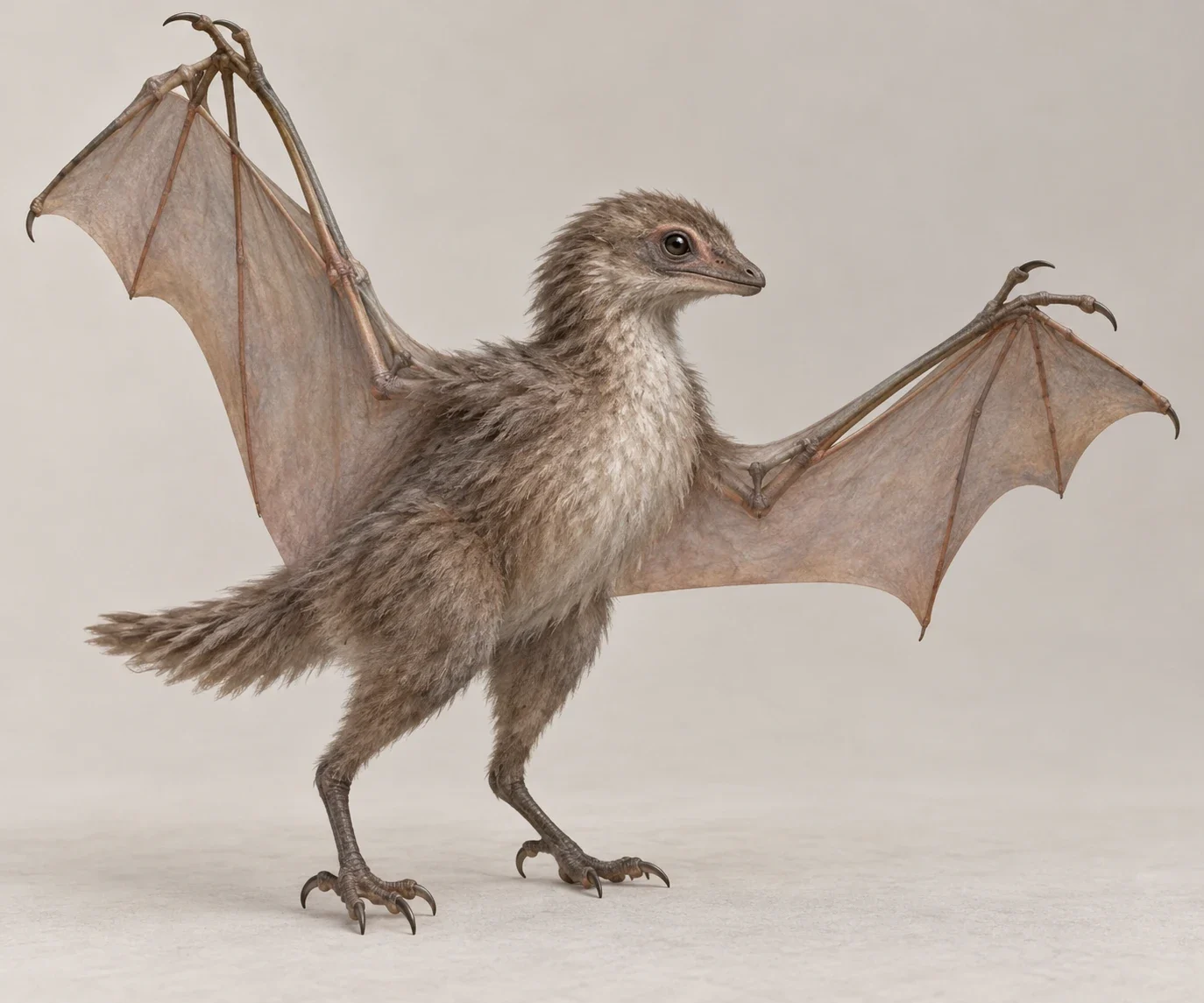
Ambopteryx longibrachium - AI-generated scientific interpretation.
Modern AI-generated scientific illustration. Diagnostic anatomy follows selected research; colour, pose and unpreserved external detail are interpretive. Not fossil or photographic evidence.
Overview
Ambopteryx belonged to the scansoriopterygids, small theropod dinosaurs close to the origins of birds. The 2019 description documented an elongate forelimb, a rodlike styliform element and preserved membrane tissue. Together these support a wing construction previously described in Yi qi, rather than an ordinary feathered bird wing.
Body feathers and a skin membrane are compatible features: a reconstruction need not choose between an entirely naked batlike animal and a modern bird. The fossil supplies anatomical evidence, but the exact outline and operational tension of a living membrane require interpretation. A membrane-shaped appendage is not sufficient proof of strong powered flight.
Dececchi and colleagues subsequently used fluorescence imaging and aerodynamic calculations to test possible locomotion. Their 2020 study found limited gliding potential and considered powered flight highly unlikely. Performance estimates depend on reconstructed wing geometry and mass. This is a bounded assessment of an unusual flight apparatus, rather than an experiment performed with a living animal or a claim that evolution deliberately tried and abandoned a design.
Origins & earliest records
Wang and colleagues named Ambopteryx longibrachium in 2019 from an Upper Jurassic specimen housed as IVPP V24192. The publication introduced a distinct scansoriopterygid with evidence relevant to membrane-wing evolution.
Evidence & interpretation
Preserved skeletal and soft-tissue features constrain the anatomical interpretation. Later imaging and aerodynamic models tested function; wing geometry, body mass and pose still carry restoration uncertainty.
Selected bibliography
Documented works and useful reading. This is not a list of every appearance.
- 01
A new Jurassic scansoriopterygid and the loss of membranous wings in theropod dinosaurs
Selected bibliography; bounded source account, not exhaustive coverage.
- 02
Aerodynamics Show Membrane-Winged Theropods Were a Poor Gliding Dead-end
Selected bibliography; bounded source account, not exhaustive coverage.
Family, evolution & connections
Taxonomic classification
A hierarchy of classified groups, not a chain of direct ancestors.
Source note: Selected phylogenetic groups follow the describing study. Its placement near birds does not make it a demonstrated direct bird ancestor.
- kingdomAnimalia
- phylumChordata
- cladeDinosauria
- cladeTheropoda
- familyScansoriopterygidae
- genusAmbopteryx
- speciesAmbopteryx longibrachium
References
Sources supporting this profile. Linked pages have their own scope and editorial standards.
- ResearchA new Jurassic scansoriopterygid and the loss of membranous wings in theropod dinosaursResearch access: 2026-10-10
- InstitutionalAerodynamics Show Membrane-Winged Theropods Were a Poor Gliding Dead-endResearch access: 2026-10-10
Image credits
AI-generated scientific interpretationAmbopteryx longibrachium - AI-generated scientific interpretation.
Modern AI-generated scientific illustration. Diagnostic anatomy follows selected research; colour, pose and unpreserved external detail are interpretive. Not fossil or photographic evidence.