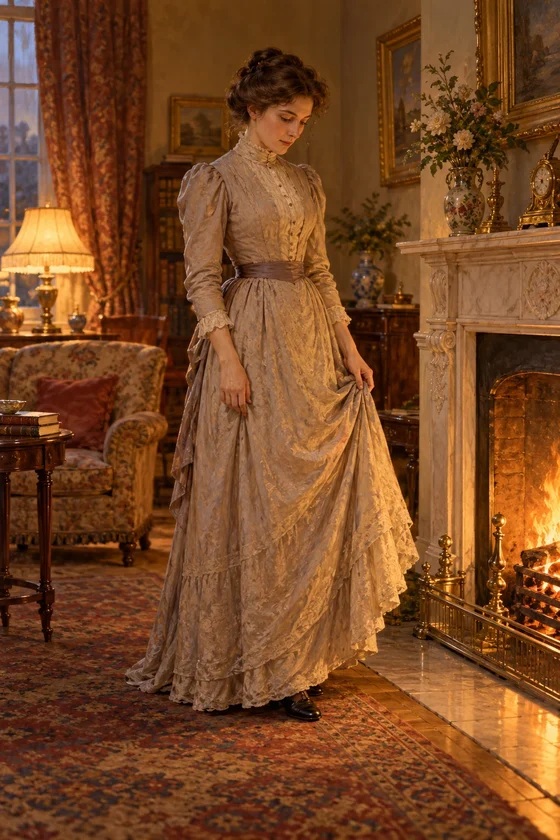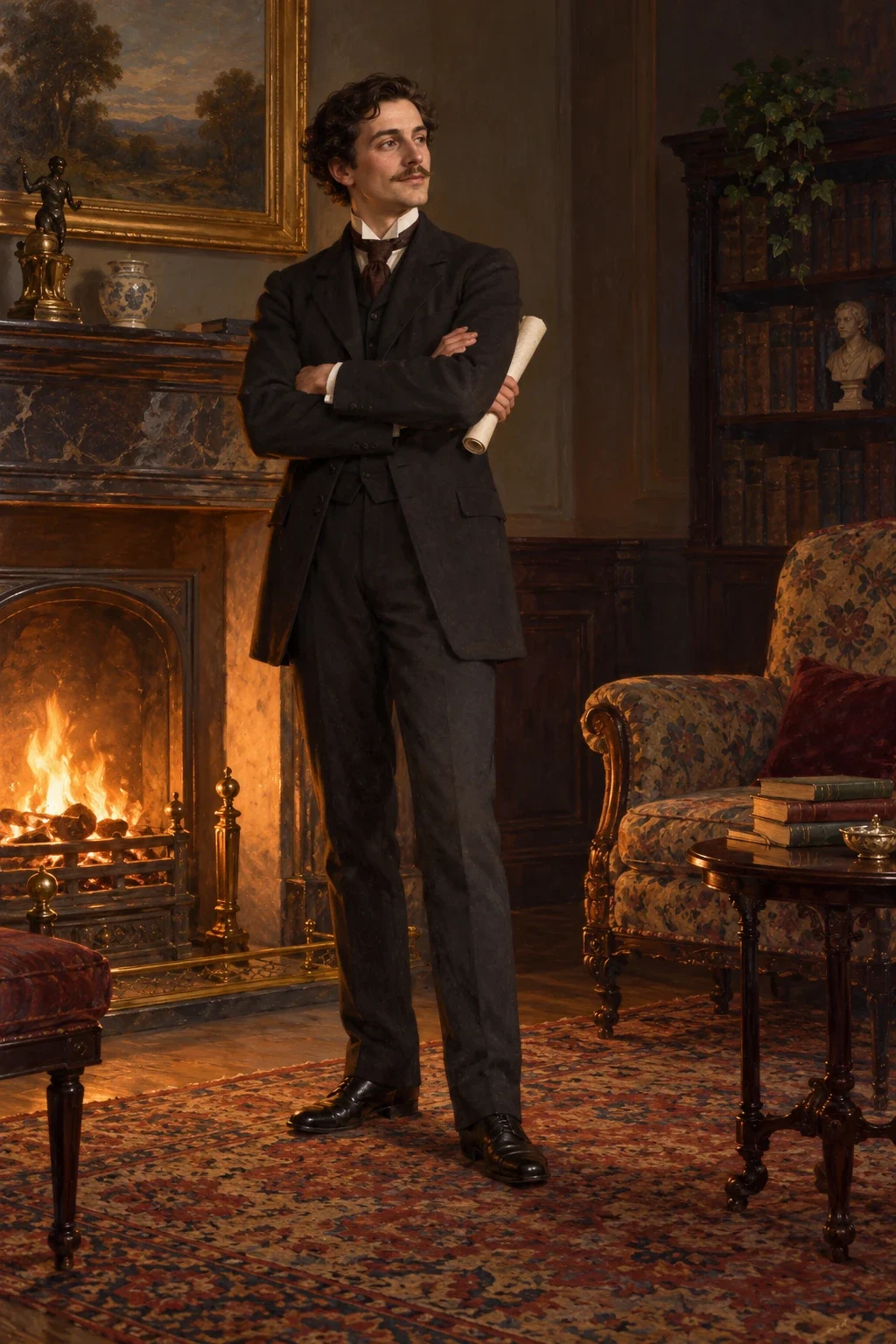
AI-generated interpretation of Allan Wayworth after reading his play; facial details and clothing are imagined.
Independent interpretation of Henry James’s fiction; exact appearance, clothing and furnishings imagined. No historical portrait, source-art reproduction or apparition claim.
Overview
Allan Wayworth is the young writer at the centre of Henry James’s Nona Vincent. At the opening he is twenty-eight, poor, ambitious and independent. After a continental education he returned to England at twenty-two; his father, a newspaper correspondent, died soon afterwards, leaving his mother and sisters with a small income in Germany. He resists journalism because it offers little place for his conception of literary form. Mrs. Alsager’s sympathetic attention gives him a refuge from professional disappointment. The narrative also exposes the vanity and dependence that accompany his artistic sincerity.
He becomes absorbed in dramatic construction and reads his completed three-act prose play to Mrs. Alsager on Christmas Day. He tells her that its heroine, Nona Vincent, has elements of her face, voice and manner; she disputes resemblance to the heroine’s conduct. Their efforts to secure a production lead to two discouraging years. He writes short dictionary biographies for money and produces another play. While he visits his family in Germany, Mrs. Alsager sends news that Loder will rehearse Nona Vincent at the Renaissance theatre.
Wayworth struggles to communicate his heroine to Violet Grey. His growing attraction to the actress complicates his anxiety about her performance: he wants her success, yet also imagines rescuing her from the stage. The first night brings applause and favourable treatment of the play, but Loder and the newspapers judge Violet unsuccessful. Wayworth defends her to her aunt, then retreats exhausted to his lodgings. At dusk he experiences the comforting presence of Nona herself. The narration associates this extraordinary impression with sleep; his landlady reports no visitor. It does not establish that Mrs. Alsager or a supernatural heroine physically entered his room.
The next evening Violet’s transformed performance delights him. She explains that Mrs. Alsager visited her for two hours, offering kindness and a living model through her speech and manner. Wayworth is moved and mystified by the parallel with his own experience. He tries to visit Mrs. Alsager, but she has returned to Torquay. By their next meeting the play has run two hundred nights and he has married Violet. His later plays sometimes succeed; his wife no longer acts, while Mrs. Alsager continues to attend performances.
First appearances & development
A distinct fictional human in Henry James’s authored third-person English tale. Artistic judgments and interpretations of affection remain attributed; not Henry James biography.
Canon & continuity
All 194 indexed units read in narrative order, including both section headings and final paragraph; original title/imprint/note/contents read. Exact paragraph references are preserved in claim-map.json.
Selected bibliography
Documented works and useful reading. This is not a list of every appearance.
- 01
The Real Thing and Other Tales — Nona Vincent
Retained Macmillan title dated 1893, copyright 1892. This is the collection edition date, not a claim about the tale’s first appearance.
Family & connections
A source-supported family tree or inspiration record has not yet been compiled for this profile. Related reading below indicates a connection in subject matter, not a proven lineage or creative influence.
References
Sources supporting this profile. Linked pages have their own scope and editorial standards.
- Primary authored English literary narrativeHenry James — complete Nona Vincent, sections I–II, pp.131–180, and original collection framingResearch access: 2026-10-23
Image credits
AI-generated fictional narrative illustrationAI-generated interpretation of Allan Wayworth after reading his play; facial details and clothing are imagined.
Independent interpretation of Henry James’s fiction; exact appearance, clothing and furnishings imagined. No historical portrait, source-art reproduction or apparition claim.