
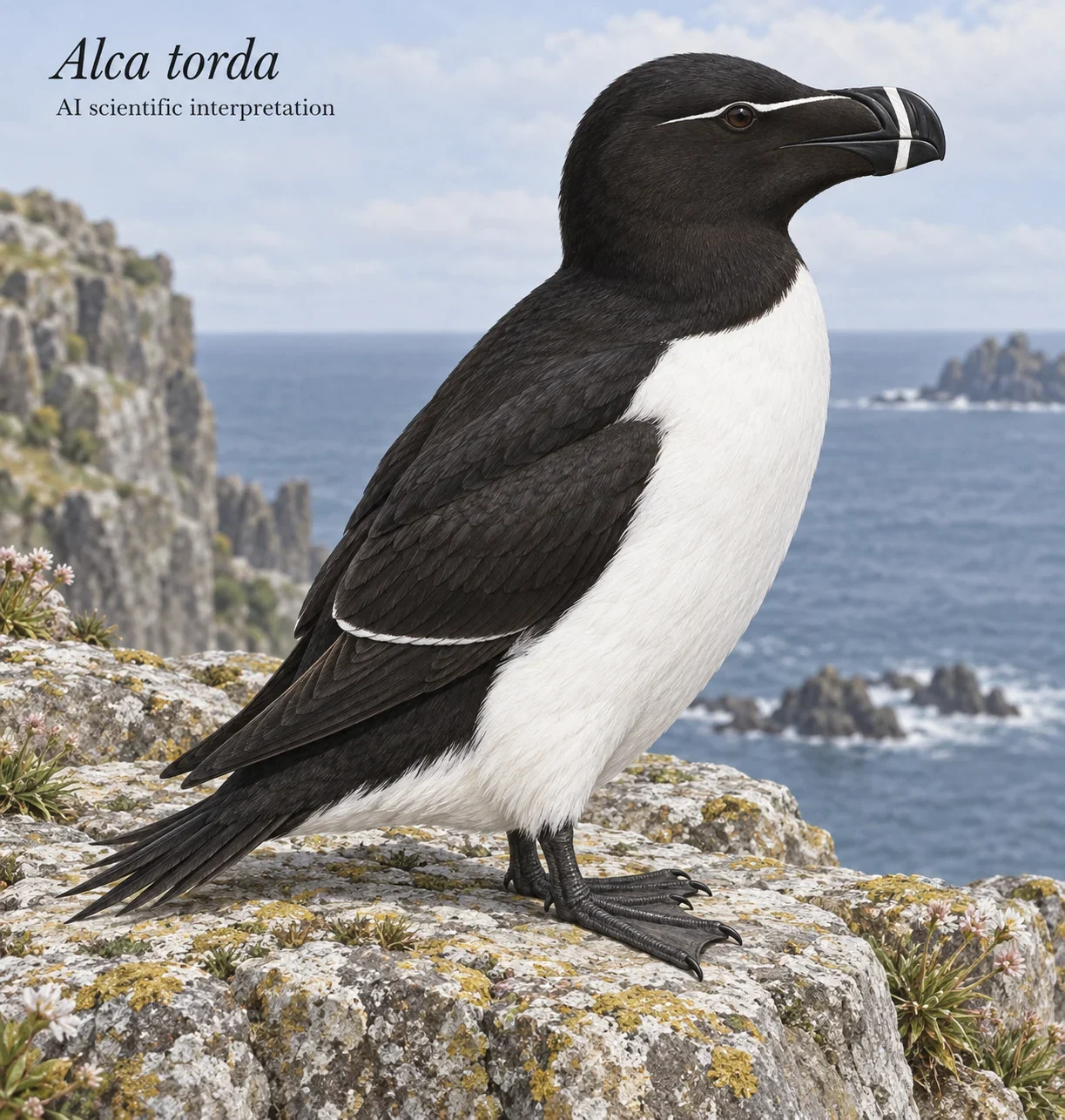
AI scientific interpretation of Alca torda.
AI scientific interpretation of an imagined Alca torda.
Overview
The Michigan account describes summer adults with dark heads and throats, white underparts, black feet and a narrow white line from eye to bill. Audubon emphasises the white band across the massive bill. Colonial breeding occurs on rocky coasts and islands, with immediate access to the sea.
Shoji and colleagues tracked eighteen breeding razorbills over three years, recording fifty-six foraging trips with GPS and dive loggers. They found broader foraging flexibility during incubation than during chick rearing, when locations concentrated in a productive area. Individual route fidelity was not supported.
The observed shift in foraging flexibility was not accompanied by a corresponding change in search patterns. Chlorophyll served as a productivity proxy, rather than a direct count of prey. The findings concern tracked breeders, not a complete Atlantic population census.
Origins & earliest records
Institutional identification accounts complement logger-based field research.
Evidence & interpretation
Breeding stage and search pattern remain distinct measured questions.
Selected bibliography
Documented works and useful reading. This is not a list of every appearance.
- 01
- 02
- 03
Family, evolution & connections
Taxonomic classification
A hierarchy of classified groups, not a chain of direct ancestors.
Source note: Michigan’s classification supplies family and order; tracking does not reconstruct ancestry.
- FamilyAlcidae
- OrderCharadriiformes
References
Sources supporting this profile. Linked pages have their own scope and editorial standards.
- Michigan educational accountAlca tordaResearch access: 2026-10-11
- Primary field researchForaging flexibility and search patterns are unlinked during breeding in a free-ranging seabirdResearch access: 2026-10-11
- Institutional field guideRazorbillResearch access: 2026-10-11
Image credits
AI-generated interpretationAI scientific interpretation of Alca torda.
AI scientific interpretation of an imagined Alca torda.