
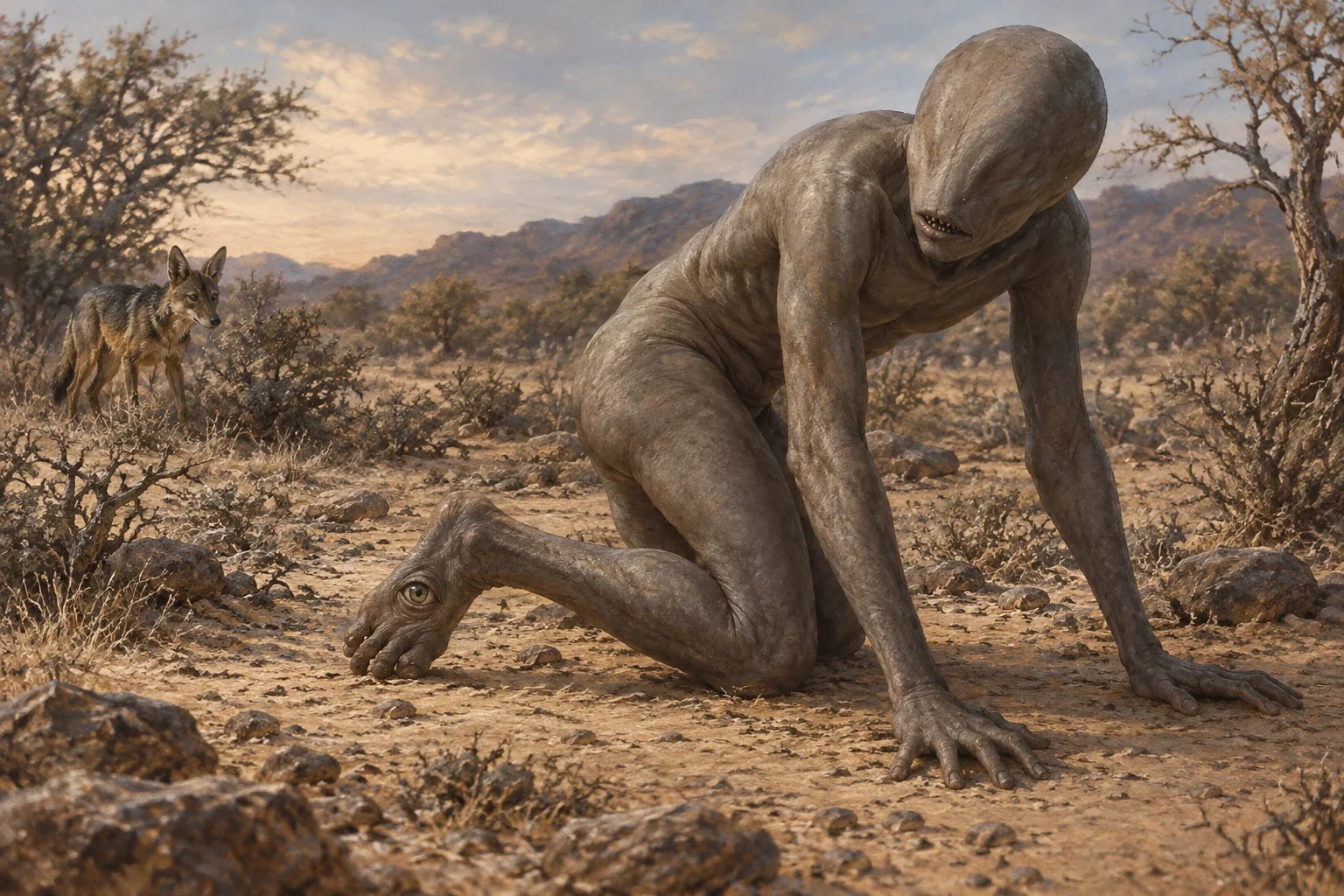
Aigamuxa - AI-generated imagined folklore illustration.
AI-generated imagined illustration of Aigamuxa based on the selected textual witness; not historical or ethnographic evidence.
Overview
Schultze’s introductory account places the beings’ eyes on the backs or upper surfaces of their feet, explicitly contrasting them with eyes in the face. Upright posture directs the eyes upward. To inspect the ground the creature supports itself on extended arms and its knees, then raises and bends a leg until its foot-eye looks horizontally backward. This witness therefore differs from widespread modern retellings that put eyes on the soles.
The collector describes communal beings with long pointed interlocking teeth that hunt humans, whom they take for zebras. Yet he also says the stories do not consistently preserve this anatomy: they often appear sufficiently human-like to deceive their intended victims. His summary and the individual episodes must therefore be read together, without forcing every episode into one anatomical model.
In tale VI, Aigamuchab and a jackal visit another settlement and share food. The jackal turns prized fatty pieces upside down, but his companion recognizes them despite having no visible facial eyes. When looking for a toothpick on the ground, the jackal discovers the hidden eyes. He requests a filled pipe, scatters tobacco into those eyes and escapes. The episode makes detection and sensory vulnerability decisive rather than raw strength.
The book presents Nama-language narrative transcriptions beside German translations with linguistic explanations. Its colonial terminology is evidence about the collector’s framing rather than a respectful contemporary community name. The printed account provides a located historical witness; it neither establishes the antiquity of the narratives nor substitutes for present-day Nama interpretation.
Origins & earliest records
Schultze, Aus Namaland und Kalahari (1907), introductory discussion pp. 392–393 and tale VI pp. 402–403; oral beginning not established.
Records & interpretation
Cached original-edition OCR inspected around lines 24430–24459 and 24920–24995. Upper-foot eye location and crouching posture are explicit in German; OCR of Nama notation is uncertain and not normalized into invented spellings.
Selected bibliography
Documented works and useful reading. This is not a list of every appearance.
- 01
Aus Namaland und Kalahari
Introduction to narratives pp. 392–393 and Aigamuchab und der Schakal, tale VI pp. 402–403.
Family & connections
A source-supported family tree or inspiration record has not yet been compiled for this profile. Related reading below indicates a connection in subject matter, not a proven lineage or creative influence.
References
Sources supporting this profile. Linked pages have their own scope and editorial standards.
- Primary recorded narrative and German translationSchultze 1907 original-edition OCRResearch access: 2026-10-10
Image credits
AI-generated imagined folklore illustrationAigamuxa - AI-generated imagined folklore illustration.
AI-generated imagined illustration of Aigamuxa based on the selected textual witness; not historical or ethnographic evidence.