
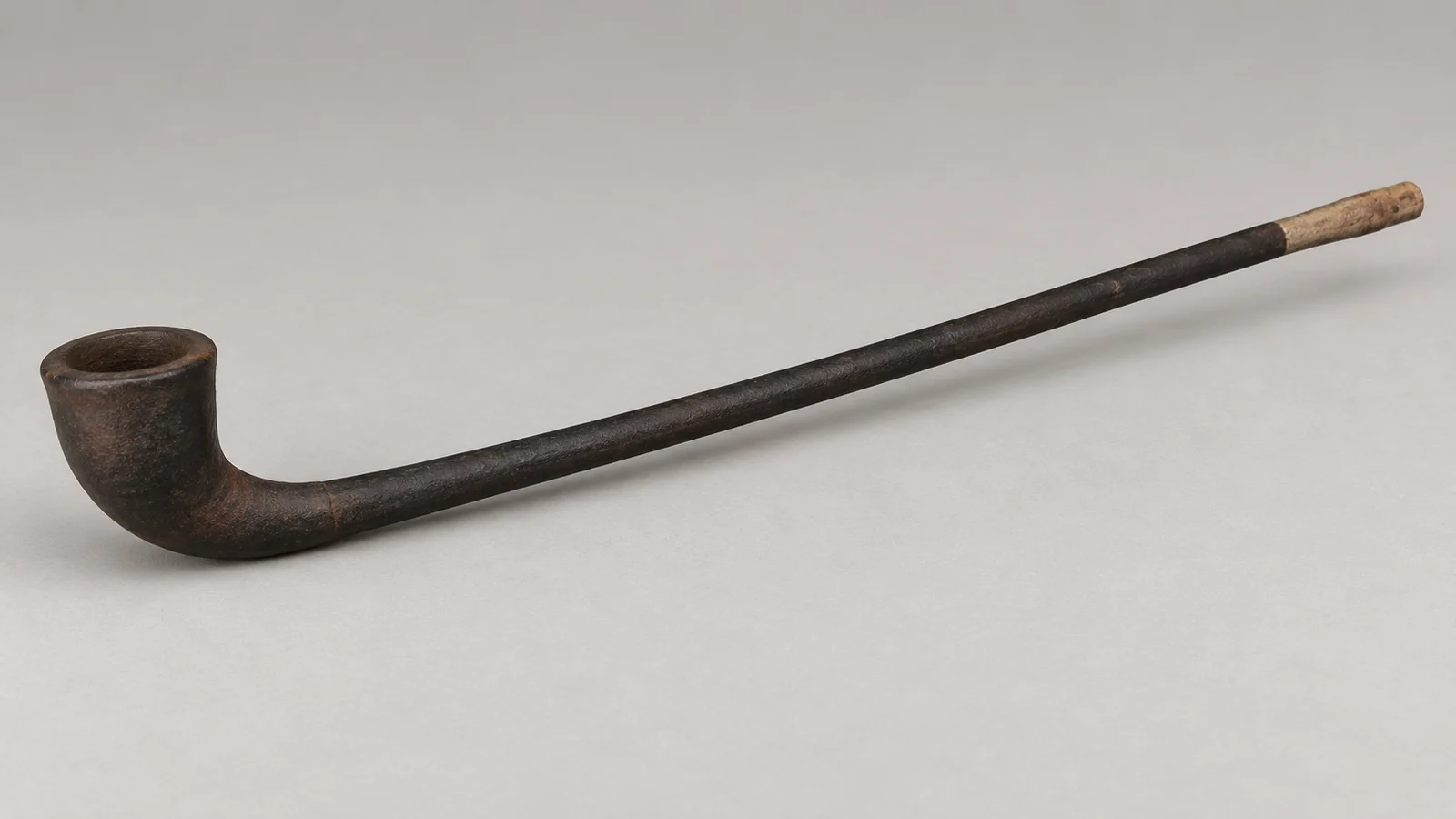
Generated interpretation of a published form; not a photographed specimen or authenticated replica. The illustrated bend is smoother than in the source photograph.
Overview
Jenks identifies Agawa as a place where a few men made clay pipes called ki-na-lo-sab. He describes working the clay between the fingers, rough shaping, partial hardening and finishing with a set of five light wooden tools. Different firing and re-burning produced gray, red or black bowls. Plate 107 is explicitly captioned finished Agawa clay pipes with stems; it shows several different bowls rather than one standardized shape. The leftmost upright example has a small, open, rounded bowl and short bent connection beneath a very long slender stem. The photographic arrangement supplies relative form but no individual measurement, stem species or maker’s name. Its monochrome tones do not establish the original colour of each displayed bowl.
The surrounding account separates local use from production for trade: Jenks reports clay and metal pipes being manufactured for exchange between Igorot communities, whereas he had not learned of comparable commercial production of wooden pipes. This does not make the Agawa clay examples identical to the metal anito pipes discussed immediately afterwards. The beeswax models, cast-metal human figures and specialist metalworkers in those paragraphs belong to that separate class and should not be transferred onto a clay bowl. Most pipes in the wider account had separable stems. The plate is credited to Jenks, and its interpretation remains bounded by his 1903 observations and the historical community labels of the survey. A contextual material study can show a pipe’s components without depicting smokers, reconstructing a ceremony or suggesting that the form represents all Bontoc or contemporary Agawa craft.
History & identity
Albert Ernest Jenks’s historical study for the colonial Ethnological Survey.
Sources & representation
Title, transmittal letter and complete preface, selected community distinctions and complete relevant craft sections read; actual native plates inspected.
Selected bibliography
Documented works and useful reading. This is not a list of every appearance.
- 01
The Bontoc Igorot
Manila, 1905; study submitted February 3, 1904 following 1903 residence. Wooden utensils, pp. 115–116, Plate 85; pipe production, pp. 130–133, Plate 107.
Language & cultural connections
Source-supported language and cultural connections have not yet been compiled for this profile.
References
Sources supporting this profile. Linked pages have their own scope and editorial standards.
- Historical colonial fieldwork accountJenks, original survey narrative and photographic platesResearch access: 2026-10-18
Image credits
AI-generatedGenerated interpretation of a published form; not a photographed specimen or authenticated replica. The illustrated bend is smoother than in the source photograph.