
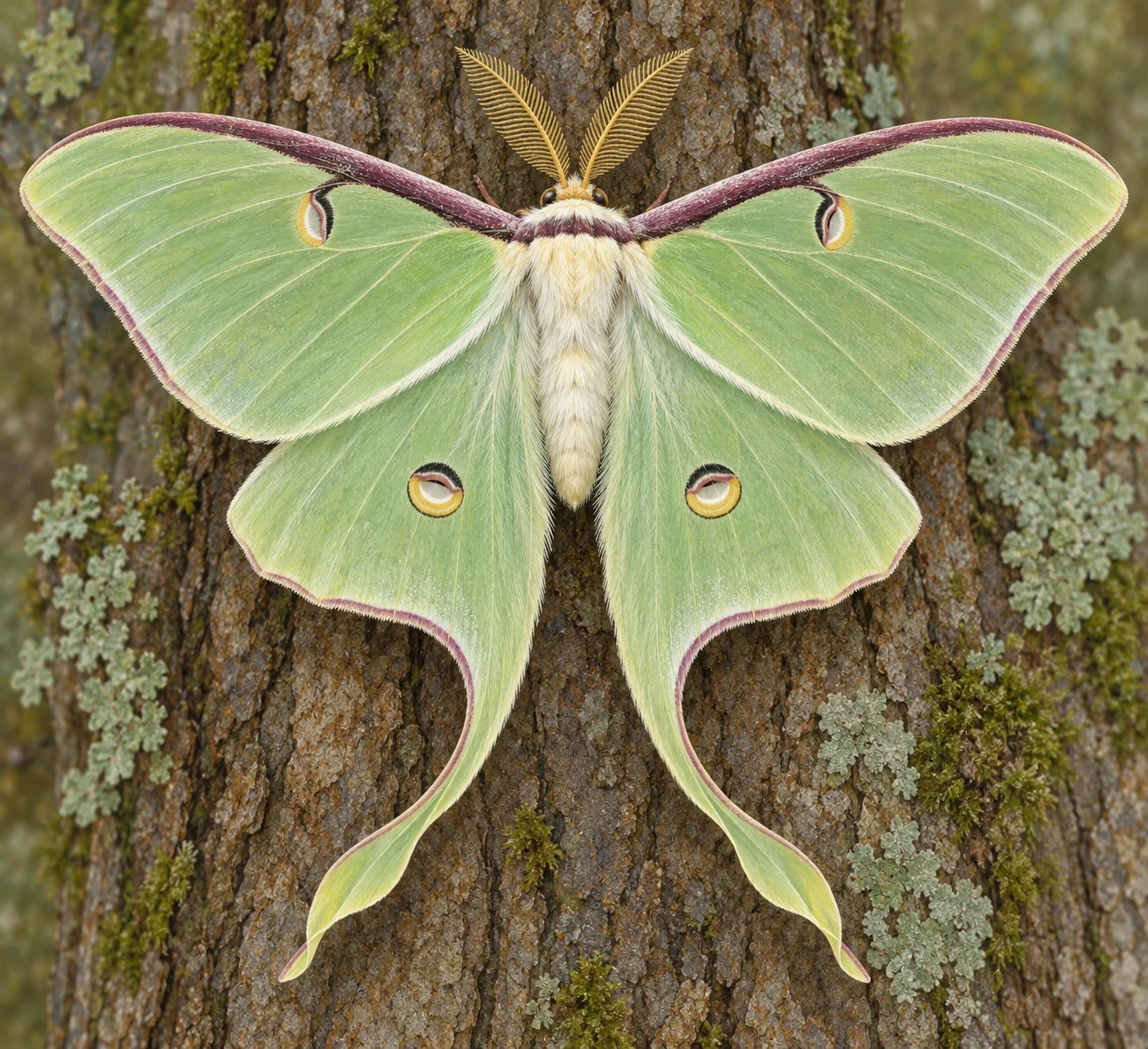
AI-generated adult male study.
Interpretation; individual and seasonal variation exists.
Overview
Luna moths inhabit forests in eastern North America. Adults have broad green wings, an eyespot on each wing and long tails extending from the hindwings. Their comb-like antennae are larger in males. Color varies with sex and season, while the number of annual generations increases toward the south.
Adults do not feed, relying on a brief reproductive life after emergence. Florida Museum curator Akito Kawahara describes experiments showing how the spinning hindwing tails divert attacks from echolocating bats. The tails act as misleading targets behind the body, allowing a moth to escape when a bat attacks the expendable trailing structure.
Origins & earliest records
Forested habitats
Evidence & interpretation
University accounts.
Selected bibliography
Documented works and useful reading. This is not a list of every appearance.
- 01
- 02
Family & connections
A source-supported family tree or inspiration record has not yet been compiled for this profile. Related reading below indicates a connection in subject matter, not a proven lineage or creative influence.
Look for a taxonomic record and classified relativesReferences
Sources supporting this profile. Linked pages have their own scope and editorial standards.
- University extension accountLuna Moth, Actias (=Tropaea) lunaResearch access: 2026-10-18
- Museum object accountLuna MothResearch access: 2026-10-18
Image credits
AI-generated illustrationAI-generated adult male study.
Interpretation; individual and seasonal variation exists.