
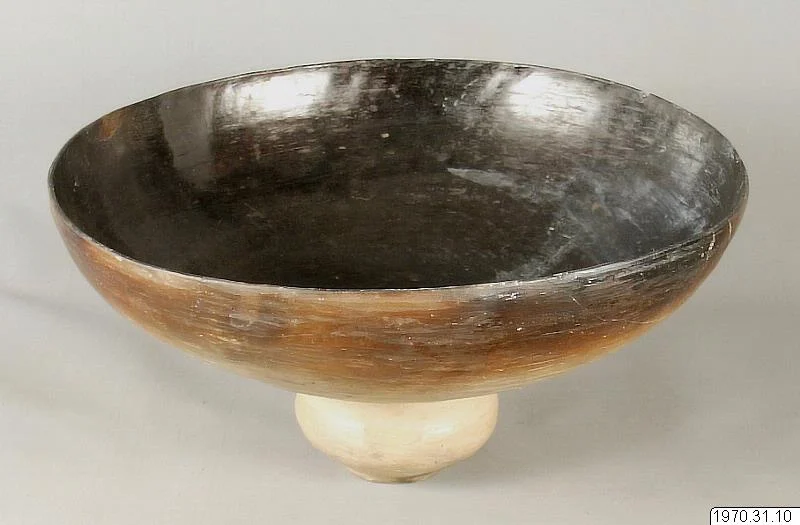
A shallow rounded ceramic vessel with a dark interior, brown outer wall and pale rounded foot, shown complete with its inventory number.
Ceramic guayusero catalogued as Achuar, from the Huasaga River area in Peru. The museum describes it as a vessel for preparing guayusa drink. Collected by Edith and Jay Louthian and acquired in 1970; that year is not a manufacture date. One household object, not a depiction of the people. Compressed for display.
Overview
Achuar is a community self-name. Peru’s ministry describes a transborder language in the Jíbaro family, spoken around the Pastaza, Corrientes and other Amazonian river systems.
Its historical synthesis records how oil exploration and the 1941 Peru–Ecuador war affected contact with outsiders. This history does not imply a single political institution across the border.
The Nacionalidad Achuar del Ecuador defines its work through collective rights, autonomy and territorial conservation. This is the Ecuadorian organisation’s stated mission, rather than proof of every Achuar community’s arrangements.
History & identity
No precise ancient origin is established here.
Sources & representation
Selected sourced accounts.
Selected bibliography
Documented works and useful reading. This is not a list of every appearance.
- 01
Achuar | BDPI
Selected bibliography.
- 02
La Nacionalidad Achuar de Ecuador | NAE
Selected bibliography.
Language & cultural connections
Source-supported language and cultural connections have not yet been compiled for this profile.
References
Sources supporting this profile. Linked pages have their own scope and editorial standards.
- Institutional accountAchuar | BDPIResearch access: 2026-10-07
- Community accountLa Nacionalidad Achuar de Ecuador | NAEResearch access: 2026-10-07
Image credits
Museum photograph of one household vesselA shallow rounded ceramic vessel with a dark interior, brown outer wall and pale rounded foot, shown complete with its inventory number.
Ceramic guayusero catalogued as Achuar, from the Huasaga River area in Peru. The museum describes it as a vessel for preparing guayusa drink. Collected by Edith and Jay Louthian and acquired in 1970; that year is not a manufacture date. One household object, not a depiction of the people. Compressed for display.